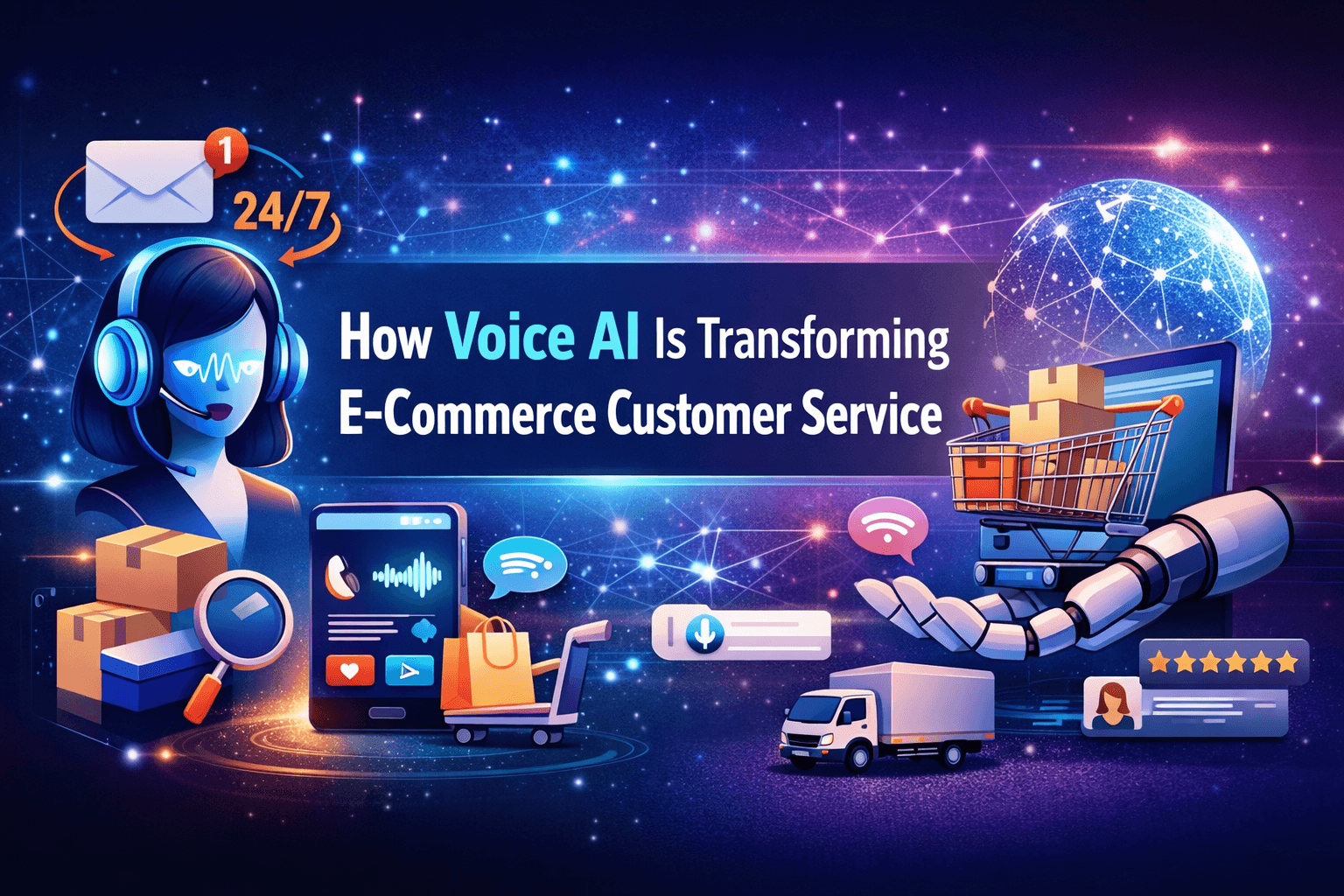
Customer expectations in e-commerce have changed dramatically over the past few years. Today’s shoppers expect instant responses, personalized recommendations, and seamless interactions across every touchpoint.
Traditional customer support systems often struggle to keep up with these demands. This is where Voice AI is making a real difference.
By enabling natural, real-time conversations between customers and online stores, Voice AI is transforming how businesses deliver support, improve engagement, and increase conversions. Businesses investing in eCommerce development services are already leveraging these advancements to stay competitive.
What Is Voice AI in E-Commerce?
Voice AI is a technology that allows systems to understand and respond to human speech using artificial intelligence. It combines speech recognition, natural language processing (NLP), and machine learning to create conversational experiences.
In e-commerce, Voice AI enables customers to:
- Search for products using voice
- Get instant support
- Place and manage orders
- Receive personalized recommendations
It essentially acts as a virtual assistant that enhances the entire shopping journey.
Voice AI works seamlessly with modern platforms supported by Shopify website development services and scalable WooCommerce website development solutions.
Why Voice AI Is Becoming Essential in E-Commerce
With the rapid growth of voice-enabled devices and mobile usage, voice interactions are becoming a preferred way for users to engage online.
Voice AI offers:
- Faster communication
- Hands-free convenience
- Better accessibility
- More natural interactions
To deliver these experiences effectively, businesses must also focus on performance using page speed optimization services and strategic growth through digital marketing and SEO services.
Businesses that adopt this technology early gain a significant competitive advantage.
Key Ways Voice AI Is Transforming Customer Service
1. 24/7 Instant Customer Support
Voice AI eliminates waiting time by providing immediate responses to customer queries at any hour.
Unlike traditional support systems, it ensures:
- No call queues
- No delayed responses
- Consistent support quality
This level of availability significantly improves customer satisfaction.
2. Personalized Shopping Experiences
One of the biggest advantages of Voice AI is its ability to deliver highly personalized experiences.
By analyzing user behavior and preferences, it can:
- Recommend relevant products
- Suggest repeat purchases
- Offer tailored deals
A seamless experience supported by web design and UI/UX services further enhances personalization and usability.
This personalization leads to higher engagement and better conversion rates.
3. Faster and Frictionless Ordering
Voice AI simplifies the buying process by allowing customers to complete actions using simple voice commands.
Customers can:
- Place orders quickly
- Track deliveries instantly
- Modify purchases without hassle
This reduces friction and makes the shopping experience smoother, especially when built on scalable platforms as discussed in the WordPress vs Shopify vs custom platform comparison.
4. Multilingual Customer Support
For businesses targeting global markets, language can be a barrier.
Voice AI solves this by supporting multiple languages and accents, enabling brands to:
- Reach a wider audience
- Improve accessibility
- Deliver localized experiences
5. Reduced Operational Costs
Automating customer service through Voice AI reduces the need for large support teams.
This helps businesses:
- Lower operational expenses
- Improve efficiency
- Scale support without increasing costs
Businesses upgrading their systems can benefit from website migration and maintenance services to ensure smooth integration.
6. Improved Customer Satisfaction and Loyalty
Fast, accurate, and personalized responses lead to better customer experiences.
When customers feel understood and supported, they are more likely to:
- Return for future purchases
- Recommend the brand
- Build long-term loyalty
A strong brand identity supported by logo and branding services also plays a key role in building trust.
Voice AI and Its Impact on SEO
Voice AI is not just transforming customer service—it also plays a role in improving search engine performance.
Voice-driven interactions help:
- Increase time spent on the website
- Reduce bounce rates
- Improve user engagement
When combined with digital marketing and SEO services, Voice AI can significantly improve search visibility.
Additionally, optimizing for voice search helps businesses appear in conversational queries and featured snippets.
Voice Commerce vs Traditional E-Commerce
| Feature | Traditional E-Commerce | Voice AI E-Commerce |
|---|---|---|
| Interaction | Text-based | Voice-based |
| Speed | Moderate | Instant |
| Experience | Static | Conversational |
| Support | Manual | Automated |
Real-World Applications of Voice AI
Voice AI is already being used in various ways across e-commerce platforms:
- Voice-based product search
- AI-powered customer support
- Smart order tracking
- Voice-enabled checkout
Many businesses are already implementing AI-optimized eCommerce strategies to stay ahead in the competitive landscape.
Challenges of Implementing Voice AI
Despite its advantages, implementing Voice AI comes with certain challenges:
- Integration with existing systems
- Data privacy concerns
- Handling complex queries
- Accuracy across different accents
Many of these issues are highlighted in common website mistakes businesses make, which businesses should actively avoid.
How to Successfully Implement Voice AI
To get the best results from Voice AI, businesses should follow a structured approach:
Choose a scalable e-commerce platform
- Integrate conversational AI tools (as explained in how to build an AI chatbot for an eCommerce website)
- Optimize website performance and speed
- Focus on user experience and navigation
- Continuously monitor and improve performance
A well-planned implementation ensures long-term success and scalability.
The Future of Voice AI in E-Commerce
Voice AI is expected to evolve rapidly in the coming years.
Future advancements may include:
- Emotion-aware interactions
- Predictive recommendations
- Deeper personalization
- Integration with smart devices
To stay competitive, businesses should follow digital marketing trends in 2026 and align with insights from website development trends in 2026.
Forward-thinking companies are also guided by the 5 tech pillars every business needs in 2026.
Conclusion
Voice AI is transforming e-commerce customer service by making it faster, smarter, and more personalized.
Businesses that embrace this technology can deliver superior customer experiences, improve efficiency, and stay ahead of the competition.
If you’re planning to implement Voice AI, starting with expert eCommerce development services or choosing to contact our team can help you move in the right direction.
In 2026 and beyond, Voice AI is not just an innovation—it is becoming a standard for modern e-commerce success.
What is Voice AI in e-commerce?
Voice AI allows customers to interact with online stores using voice commands for searching products, placing orders, and getting support.
How does Voice AI improve customer experience?
Is Voice AI suitable for small businesses?
Yes, Voice AI helps small businesses automate support and compete with larger brands efficiently.
Does Voice AI help with SEO?
What is the future of Voice AI in e-commerce?
The future includes smarter, more human-like interactions, deeper personalization, and integration with emerging technologies.