The Great Digital Reset of 2026
The digital landscape hasn’t just “evolved” in 2026; it has been entirely rewritten. We have officially moved past the era of static websites and basic SEO. Today, your digital presence is judged by two uncompromising critics: Artificial Intelligence and The 0.5-Second User.
If your website still relies on 2023 architecture, you aren’t just falling behind your competitors—you’re becoming invisible to search engines. Google’s latest updates now prioritize “Utility” and “Instantaneous Response” over everything else. To rank, you must provide a near-native experience that feels less like a website and more like a high-speed application.
1. Agentic AI (Autonomous Operators)
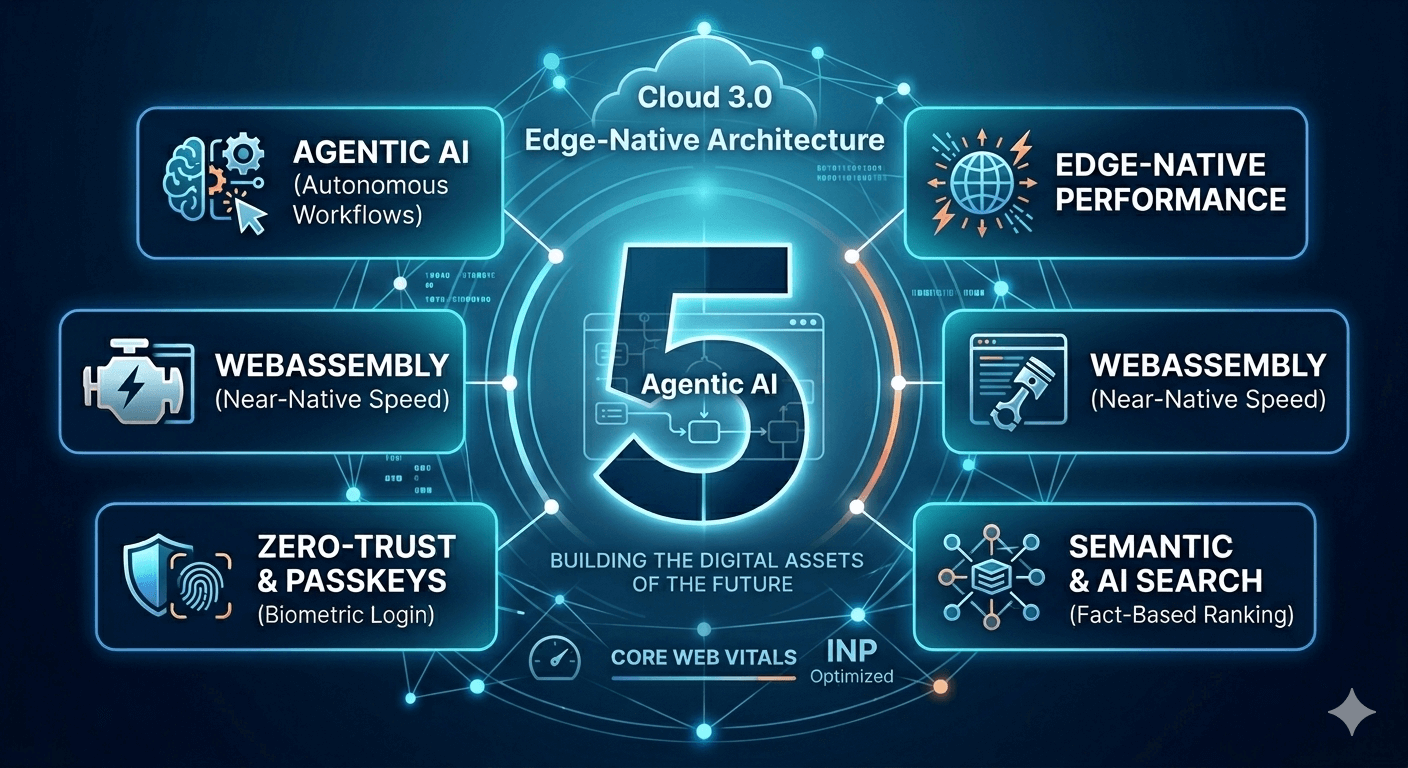
In 2026, we have graduated from “Generative AI” (which just writes text) to “Agentic AI” (which performs work). An AI Agent is a goal-oriented system integrated into your website that can use tools, access your database, and make decisions within a set of guardrails.
- The Workflow: Unlike a standard chatbot that says, “Please call our support line,” an Agentic system can verify a user’s identity via Passkey, check their order history, interact with a shipping API to track a lost package, and issue a partial refund—all in one session.
- Business Impact: This technology transforms your website from a passive information source into an active employee. It reduces the “friction to purchase” by solving customer problems in real-time without human intervention.
Tip from Zeroradius:
Before deploying agents, focus on Data Cleanliness. Agents rely on precise Schema Markup and structured API endpoints. If your internal data architecture is disorganized, the AI will provide halluncinated or incorrect actions.
2. Edge-Native Performance & "Cloud 3.0"
The traditional cloud model—where a user in Dubai waits for a server in Virginia to respond—is dead. Edge-Native architecture means your website’s code, logic, and even parts of its database live on hundreds of small “nodes” globally.
- The Tech: We utilize Edge Functions (like Vercel Edge or Cloudflare Workers) to execute code milliseconds away from the user. This enables “Instant Rendering,” where the page is fully interactive before the user even finishes their click.
- Why it Matters: Google’s 2026 search algorithm focuses heavily on INP (Interaction to Next Paint). If your site feels sluggish because it’s waiting for a distant server, your rankings will plummet regardless of your content quality.
Tip from Zeroradius:
Implement Edge Personalization. Instead of using heavy client-side tracking scripts that slow down the browser, use Edge logic to swap content and calls-to-action instantly based on the user's geolocation and headers.
3. WebAssembly (Wasm) for Native-Level Power
For decades, the web was limited by the speed of JavaScript. WebAssembly (Wasm) is a binary instruction format that allows us to run heavy, high-performance languages like Rust, C++, and Go directly in the browser.
- The Evolution: This allows websites to handle massive computational tasks—like 4K video editing, complex financial modeling, or real-time 3D rendering—at speeds previously only possible with downloaded software.
- The SEO Angle: High-performance tools built with Wasm create incredible “User Dwell Time.” When users spend 10+ minutes interacting with a high-speed tool on your site, Google interprets your domain as a high-value authority.
Tip from Zeroradius:
For high-conversion eCommerce, use Wasm to power 3D Product Configurators. This allows customers to customize products in high-definition 3D with zero lag, which typically increases "Add-to-Cart" rates by over 30%.
4. Zero-Trust Security & Passwordless Auth
In 2026, AI is being used by hackers to generate millions of “credential stuffing” attacks every hour. The response is Zero-Trust Security: a model where no one is trusted by default, and every single request to your server must be continuously verified.
- Passkeys over Passwords: We are replacing traditional passwords with Passkeys (WebAuthn). These use device-level biometrics (FaceID/Fingerprint) to log users in. They cannot be phished, guessed, or stolen in a data breach.
- Micro-Segmentation: We build websites where the “front door” and the “database” are strictly separated. Even if a hacker finds a vulnerability in a UI component, they are blocked from accessing sensitive customer data.
Tip from Zeroradius:
Switch to Passwordless Authentication immediately. By removing the "forgot password" barrier, most platforms see a direct recovery of up to 20% of abandoned checkouts caused by login friction.
5. Semantic SEO & AI-Readable Content
Google 2026 has moved away from matching “keywords” to matching “entities.” Their AI search engine, Gemini, looks for specific Nodes of Information to answer user queries directly in the search results.
- Entity-Based Content: Your content must now be structured with JSON-LD Structured Data. This tells Google’s AI exactly what your product is, who your experts are, and what problems you solve.
- The “Source” Factor: To rank, you must be the “Source of Truth.” This means writing deep, original research and data-driven insights that AI engines want to cite as their primary reference.
Tip from Zeroradius:
Don’t just write for humans; write for Large Language Models (LLMs). Use a clear, logical heading hierarchy and concise "answer blocks" to increase the probability of your site being the "Featured Source" in AI-generated summaries.
How long does it take to upgrade a site to 2026 standards?
Is Edge-Native hosting more expensive?
Can these technologies be added to my existing WordPress or Shopify site?
Building for the Next Decade
In 2026, technology is no longer a “support” function for your business—it is the business. The gap between companies using legacy systems and those utilizing Agentic AI, Edge-Native performance, and Zero-Trust security is widening every day. A website that is slow, insecure, or “AI-blind” is a liability that costs you revenue every hour it stays online.
At Zeroradius, we don’t just build websites; we build digital assets designed to withstand the rapid shifts of the AI era.
Don’t let your digital presence get stuck in the past.