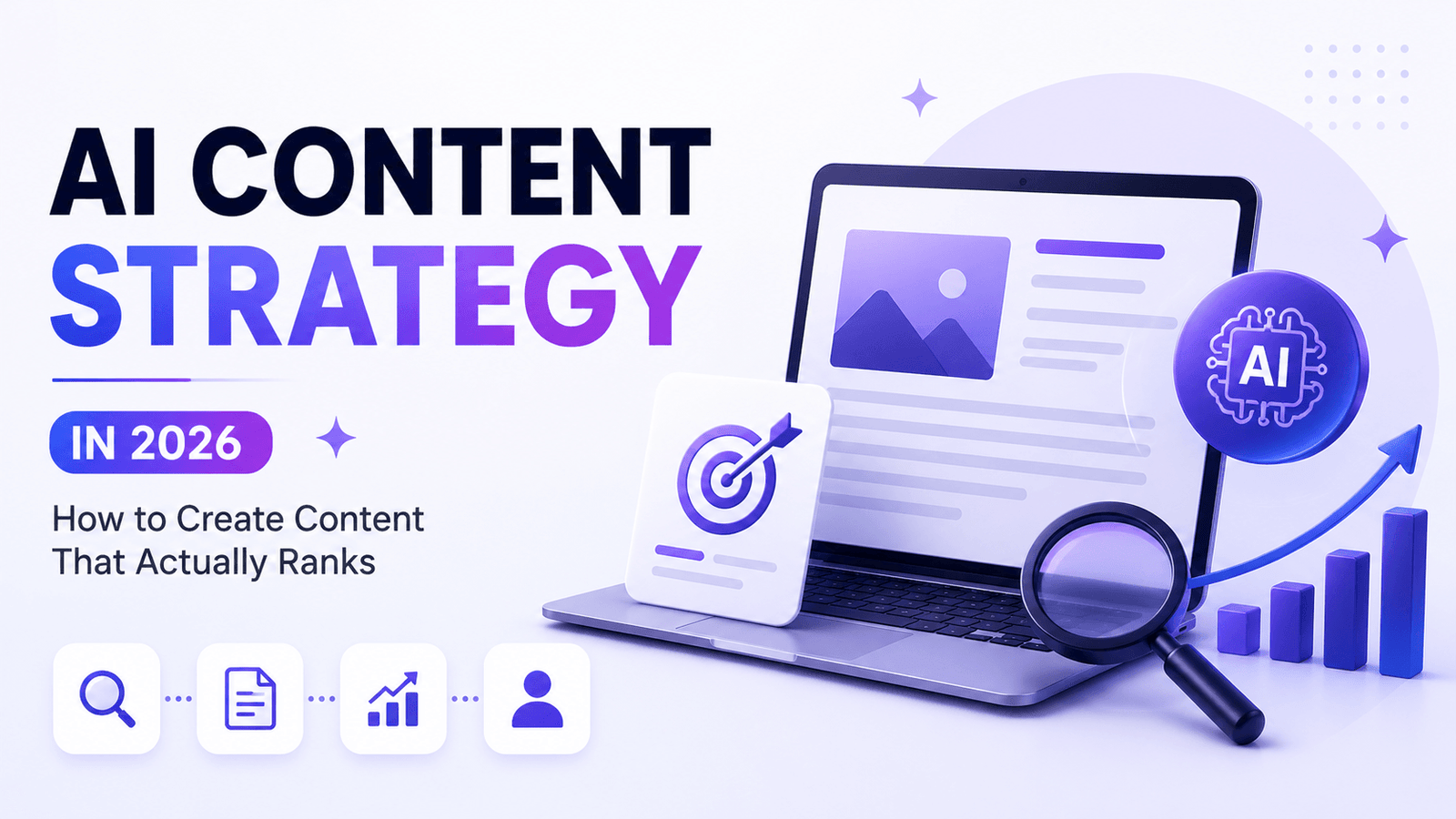
Content marketing is changing rapidly. In 2026, publishing random blog posts is no longer enough to grow organic traffic consistently. Search engines are becoming smarter, AI-generated answers are becoming more common, and users expect higher-quality information than ever before.
Google’s AI-powered search experience now focuses heavily on helpful content, topical authority, trust signals, user engagement, and real expertise.
This means businesses need a smarter content strategy — not just more content.
In this guide, you’ll learn how to build an AI content strategy in 2026 that helps your website rank faster, appear in AI Overviews, and generate long-term organic traffic.
What Is an AI Content Strategy?
An AI content strategy is a modern SEO approach focused on creating highly structured, experience-driven, user-focused content that AI systems can easily understand and recommend.
Instead of focusing only on keywords, AI content strategy combines:
- Topical authority
- Search intent
- User experience
- Content depth
- Semantic SEO
- Trust signals
- Internal linking
- Conversational search optimization
The goal is simple: create content that genuinely helps users while making it easier for search engines and AI systems to understand your expertise.
Why AI Content Strategy Matters in 2026
Search behavior has changed dramatically. Users now ask longer, more conversational questions. Instead of searching for “best SEO agency,” they ask:
- Which SEO strategy works best in 2026?
- How do websites rank in AI Overviews?
- What improves topical authority for SEO?
- How can small businesses grow organic traffic faster?
Google’s AI systems try to generate direct answers for these questions. If your content is clear, well-structured, and trustworthy, it has a higher chance of being referenced in AI-generated results.
If you want to understand how AI-powered search is evolving, read our guide on Google AI Mode in 2026.
1. Build Topic Clusters Instead of Isolated Posts
One of the biggest SEO mistakes businesses still make is publishing disconnected blog posts without a clear structure.
Google now prefers websites that deeply cover a topic from multiple angles.
Example of a Strong Topic Cluster
Main Pillar Post
AI Content Strategy in 2026
Supporting Cluster Articles
- How to Rank in AI Overviews
- Trust Signals for AI SEO
- Core Web Vitals Optimization Guide
- How to Build Topical Authority
- AI SEO Mistakes to Avoid
- Conversational SEO Strategies
This structure helps search engines understand that your website has expertise around a complete subject area.
2. Focus on Search Intent First
Many websites still create content based only on keywords. But in 2026, search intent matters much more.
You must understand what users actually want when they search.
Types of Search Intent
- Informational: Users want answers or education
- Commercial: Users compare solutions before buying
- Transactional: Users are ready to take action
- Navigational: Users search for a specific brand or website
Content that matches intent usually performs better because users stay longer, engage more, and trust the website.
3. Create Human-First Content
AI-generated content is everywhere now. Because of this, Google increasingly values content that feels human, practical, and experience-driven.
Instead of creating robotic articles, focus on:
- Real examples
- Case studies
- Practical insights
- Clear explanations
- Personal observations
- Actionable advice
For example, instead of saying “website speed is important,” explain how improving loading speed reduced bounce rate or improved conversions.
Human-first content also supports stronger trust signals. You can learn more in our article on trust signals for AI SEO.
4. Structure Content for AI Readability
AI systems prefer content that is easy to scan and understand.
That means your content structure matters almost as much as the content itself.
Best Practices for Content Structure
- Use H2 and H3 headings clearly
- Keep paragraphs short
- Add bullet points
- Use numbered steps
- Answer questions directly
- Add FAQ sections
- Use semantic keywords naturally
This improves readability for both users and search engines.
5. Improve Website Performance
Even the best content can struggle if the website experience is poor.
Slow loading speed, layout shifts, poor mobile experience, and heavy scripts can negatively affect rankings and engagement.
Important Performance Areas
- Core Web Vitals
- Mobile optimization
- Fast hosting
- Optimized images
- Efficient caching
- Minimal unnecessary plugins
If you are using WordPress, performance optimization becomes even more important. Read our Core Web Vitals Optimization Guide 2026 for detailed optimization strategies.
6. Use Strong Internal Linking
Internal links help users discover related content while helping search engines understand the structure of your website.
For AI SEO, internal linking strengthens topical authority.
For example, a blog about AI content strategy should naturally link to related articles such as:
- Google AI Mode
- AI SEO trust signals
- WordPress performance optimization
- Website UX improvements
- SEO pricing guides
Strong internal linking creates a more connected and authoritative content ecosystem.
7. Optimize for AI Overviews
AI Overviews are becoming one of the biggest visibility opportunities in Google Search.
To improve your chances of appearing in AI-generated summaries:
- Answer questions clearly
- Use structured formatting
- Provide concise explanations
- Add FAQ sections
- Use schema markup
- Build trust signals
Content that is clear and easy to summarize is more likely to be referenced by AI systems.
8. Build Brand Authority Alongside Content
SEO is no longer isolated from branding. Google increasingly analyzes brand reputation across the web.
This includes:
- LinkedIn presence
- YouTube content
- Reviews
- Brand mentions
- Community engagement
- Case studies
- Industry recognition
Brands with strong digital authority often gain better visibility in AI-powered search results.
9. Refresh Existing Content Regularly
Updating old content is one of the fastest ways to improve rankings.
Instead of publishing endless new posts, improve existing articles by updating:
- Statistics
- Examples
- Screenshots
- SEO strategies
- Internal links
- FAQs
- Schema markup
Fresh content signals help search engines understand that your website remains relevant and maintained.
10. Use Conversion-Focused UX
Ranking alone is not enough. Your content should also help users take action.
A strong user experience improves engagement, trust, and conversions.
Important UX Elements
- Clear navigation
- Readable layouts
- Strategic CTAs
- Fast mobile experience
- Simple forms
- Strong visual hierarchy
If your website needs a stronger conversion-focused structure, explore our UI/UX design services.
Common AI Content Strategy Mistakes
Publishing Thin Content
Short, generic content without depth often struggles to rank.
Ignoring Search Intent
Content that does not match user expectations creates poor engagement.
Weak Internal Linking
Disconnected content reduces topical authority.
Overusing Keywords
Keyword stuffing hurts readability and trust.
Ignoring Mobile Experience
Most traffic now comes from mobile devices, making mobile UX essential.
Final Thoughts
AI content strategy in 2026 is not about producing the highest number of blog posts. It’s about creating the most helpful, structured, trustworthy, and experience-driven content possible.
The websites that win in AI-powered search will combine strong topical authority, user-focused content, fast performance, internal linking, and real expertise.
Businesses that adapt early can gain significant visibility advantages as Google continues moving toward AI-driven search experiences.
FAQs
What is AI content strategy?
AI content strategy is an SEO approach focused on creating structured, helpful, and experience-driven content optimized for AI-powered search systems.
Why does topical authority matter in 2026?
Topical authority helps search engines understand that your website deeply covers a subject, improving rankings and AI visibility.
Do AI Overviews affect SEO?
Yes. AI Overviews can increase or reduce website visibility depending on how well your content is optimized for AI-powered search.
Does content structure matter for AI SEO?
Yes. Clear headings, short paragraphs, FAQs, and structured formatting help AI systems understand content more effectively.
Can AI-generated content rank?
Yes, but only if it provides real value, strong structure, helpful insights, and a good user experience.