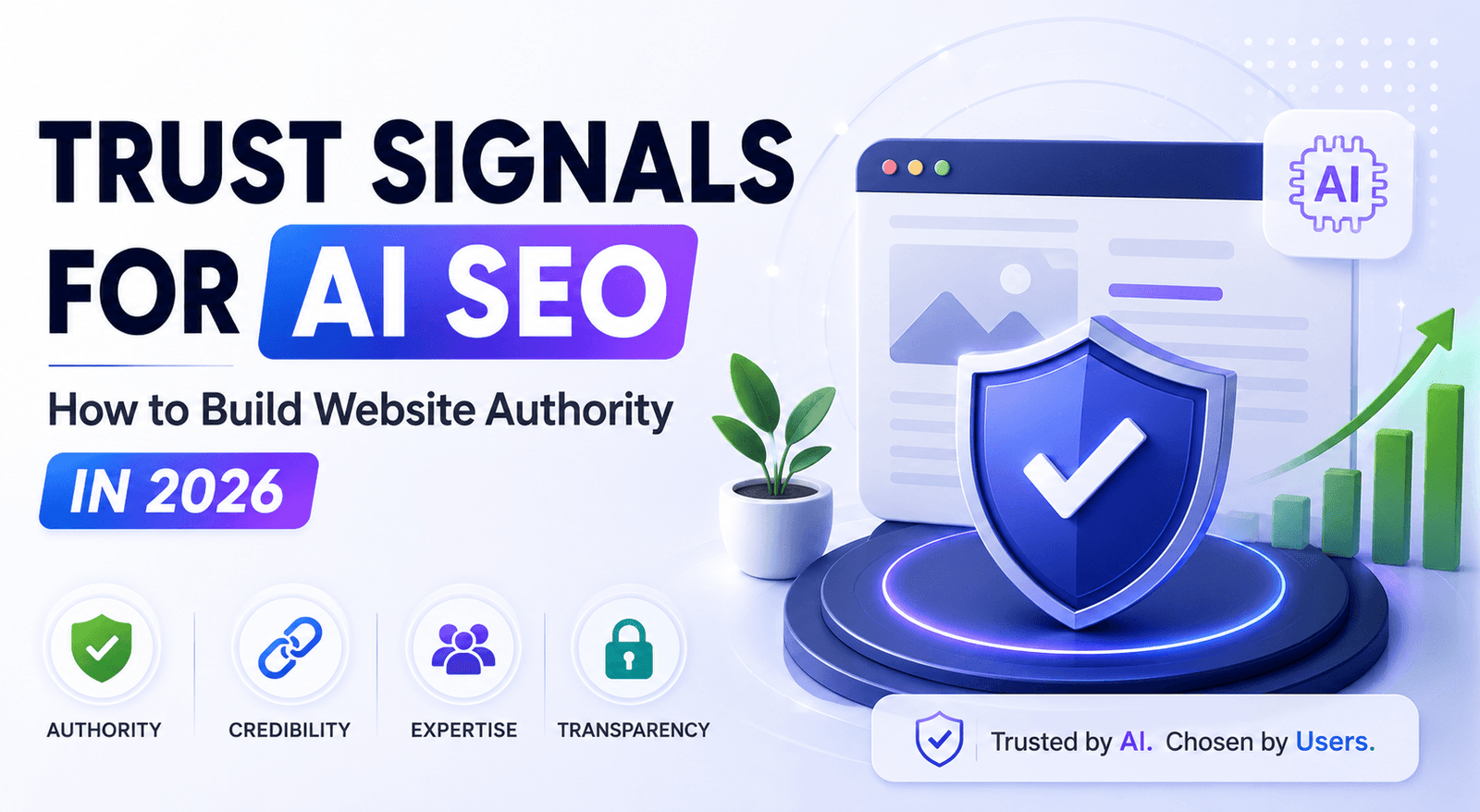
Search engine optimization is no longer only about keywords and backlinks. In 2026, Google is becoming more intelligent, more selective, and more focused on trust.
With AI Overviews, Google AI Mode, and conversational search experiences becoming more common, websites need to prove that they are reliable sources of information.
This is where trust signals become extremely important.
If your website looks credible, provides helpful content, has a strong brand presence, and delivers a smooth user experience, it has a better chance of ranking higher and appearing in AI-generated search results.
In this guide, you’ll learn how to build strong trust signals for AI SEO in 2026 and improve your website’s authority.
What Are Trust Signals in SEO?
Trust signals are elements that help search engines and users understand that your website is credible, safe, and reliable.
These signals can include your business information, content quality, website security, author details, reviews, case studies, contact information, structured data, and overall user experience.
In simple words, trust signals tell Google that your website is real, useful, and worth recommending.
Why Trust Signals Matter More in AI SEO
AI-powered search experiences do not simply list websites. They summarize information, compare options, and recommend answers directly to users.
That means Google must be careful about which sources it trusts. If a website provides unclear, outdated, thin, or unreliable information, it is less likely to be selected for AI-powered results.
For businesses, this means trust is now a major part of SEO success.
If you want your website to perform better in Google AI Mode, you should also read our guide on how to prepare your website for Google AI Mode in 2026.
1. Create a Strong About Page
Your About page is one of the most important trust-building pages on your website.
Many businesses treat it as a simple company introduction, but for SEO, it can do much more. A well-written About page helps Google and users understand who you are, what you do, who you help, and why your brand should be trusted.
Your About Page Should Include:
- Your company story
- Your services
- Your industry experience
- Your mission
- Your team or leadership details
- Your location
- Your achievements
- Your client focus
A generic About page will not create strong authority. Make it specific, human, and clear.
2. Add Clear Contact Information
A trustworthy website should make it easy for visitors to contact the business.
If users cannot find your email, phone number, location, or contact form, they may hesitate to trust your brand. Search engines may also treat unclear business information as a weak trust signal.
Add These Contact Details:
- Business email address
- Phone number
- Office address
- Contact form
- Google Maps location
- Social media links
This is especially important for service-based businesses, agencies, eCommerce companies, and local businesses.
3. Show Real Client Reviews and Testimonials
Reviews and testimonials are powerful trust signals because they show that real people have worked with your business.
For AI SEO, testimonials can support your brand authority and help users feel confident before taking action.
Best Places to Add Testimonials:
- Homepage
- Service pages
- Case study pages
- Landing pages
- About page
- Proposal pages
If possible, include client names, company names, images, project details, and measurable results.
4. Publish Case Studies
Case studies are stronger than normal testimonials because they show proof of your work.
A good case study explains the client problem, your solution, your process, and the final result. This creates experience-based content, which is valuable for SEO and AI visibility.
A Strong Case Study Should Include:
- Client background
- Main challenge
- Strategy used
- Tools or technologies used
- Results achieved
- Before and after comparison
For example, if you improved a website’s speed, show the before and after performance scores. If you improved conversions, explain what changes helped users take action.
5. Improve Website Design and User Experience
Trust is not only created through content. Design also plays a major role.
If your website looks outdated, cluttered, slow, or confusing, users may leave quickly. This can reduce engagement and hurt your SEO performance.
A professional design helps users feel that your business is active, reliable, and serious about quality.
If your website needs a stronger visual structure, conversion-focused layout, or better user journey, explore our web design UI/UX services.
UX Trust Signals Include:
- Clean navigation
- Readable typography
- Fast loading pages
- Mobile-friendly layout
- Clear call-to-action buttons
- Professional branding
- Consistent spacing
- Simple contact flow
6. Secure Your Website with HTTPS
Website security is a basic but essential trust signal.
If your website is not using HTTPS, users may see browser warnings. This can immediately damage trust and reduce conversions.
For SEO, HTTPS is also important because Google prefers secure websites. Every business website should use a valid SSL certificate and keep security settings updated.
For WordPress websites, security is especially important because outdated plugins, weak passwords, and poor maintenance can create vulnerabilities. You can learn more from our guide on how to secure your WordPress website in 2026.
7. Add Author Information to Blog Posts
Author information helps users and search engines understand who created the content.
This is especially important for topics that require expertise, such as SEO, web development, eCommerce, finance, health, law, and technical guides.
Author Bio Should Include:
- Author name
- Role or expertise
- Short bio
- LinkedIn profile
- Relevant experience
- Other published articles
Even a simple author box can improve transparency and trust.
8. Use Structured Data for Better AI Understanding
Structured data helps search engines understand your website content more clearly.
It gives additional context about your business, articles, services, products, FAQs, reviews, and breadcrumbs.
Important Schema Types for Trust:
- Organization schema
- LocalBusiness schema
- Article schema
- FAQ schema
- Review schema
- Service schema
- Breadcrumb schema
Schema does not guarantee rankings, but it can improve how clearly search engines understand your website.
9. Keep Your Content Updated
Outdated content can weaken trust.
If your blog posts mention old tools, outdated statistics, broken links, or expired strategies, users may lose confidence in your website.
Search engines also prefer fresh and accurate content for topics that change frequently.
Update These Elements Regularly:
- Blog statistics
- Tool recommendations
- Internal links
- External links
- FAQs
- Meta descriptions
- Screenshots
- Schema markup
Website maintenance also plays a major role in long-term SEO. Read our Website Maintenance Cost Guide 2026 to understand what should be included in a proper maintenance plan.
10. Build High-Quality Internal Links
Internal links help users discover related content and help search engines understand the relationship between your pages.
For AI SEO, internal linking is especially important because it supports topical authority.
For example, if you publish content about AI SEO, you should internally link to related topics such as Core Web Vitals, Google AI Mode, content optimization, web design, WordPress development, and SEO pricing.
This helps Google understand that your website covers the topic deeply.
11. Improve Website Speed and Core Web Vitals
A slow website creates poor trust. Users expect websites to load quickly, especially on mobile devices.
Core Web Vitals are important because they measure real user experience. If your website loads slowly or shifts while loading, users may leave before reading your content.
To improve speed, optimize images, reduce unnecessary scripts, use caching, improve hosting, and remove heavy plugins.
For a complete performance breakdown, read our Core Web Vitals Optimization Guide 2026.
12. Build Brand Mentions Outside Your Website
Google does not only look at your website. It can also understand brand signals from other platforms.
Brand mentions across trusted platforms can strengthen your overall authority.
Useful Brand Authority Channels:
- YouTube
- Google Business Profile
- Industry directories
- Guest posts
- Podcast mentions
- Review platforms
- Online communities
When users and platforms mention your brand naturally, it helps build credibility over time.
Common Trust Signal Mistakes to Avoid
Using Generic AI Content
Generic content without examples, depth, or originality does not build trust.
Hiding Business Information
If users cannot find who owns the website or how to contact the business, trust drops quickly.
Ignoring Mobile Experience
A poor mobile layout can reduce engagement and conversions.
Not Updating Old Blogs
Old and outdated information can damage credibility.
Weak Internal Linking
Without internal links, search engines may struggle to understand your site structure.
Final Thoughts
Trust signals are becoming one of the most important parts of SEO in 2026.
As Google moves deeper into AI-powered search, websites must prove that they are credible, helpful, secure, and authoritative.
To build stronger trust signals, focus on clear business information, helpful content, real reviews, case studies, author details, website speed, structured data, and consistent brand presence.
The future of SEO belongs to brands that users trust and AI systems can confidently understand.
FAQs
What are trust signals in SEO?
Trust signals are elements that show search engines and users that your website is credible, safe, reliable, and useful.
Why are trust signals important for AI SEO?
AI-powered search systems need reliable sources to generate answers. Strong trust signals help your website become a more credible source.
Do reviews help SEO?
Yes. Reviews can improve user trust, support local SEO, and help visitors feel more confident about choosing your business.
Does website speed affect trust?
Yes. A fast website creates a better user experience and helps users trust your brand more.
How can I improve website authority in 2026?
You can improve authority by publishing helpful content, adding case studies, improving internal links, using schema, building reviews, and maintaining a strong brand presence.