Online shopping is changing again.
For many years, ecommerce growth was mostly shaped by search engines, social media, marketplaces, paid ads, and email marketing. A customer searched for a product, clicked a website, compared options manually, and made a buying decision.
Now, AI is starting to sit between the customer and the store.
Instead of searching manually, a shopper can ask an AI assistant something like:
- Find me a compact coffee grinder that fits on a small kitchen counter.
- Compare running shoes under ₹5,000 for daily walking.
- Find a gift for a designer who works from home.
The AI assistant can understand the request, search available products, compare options, check details, and guide the shopper toward a purchase.
This is called agentic commerce.
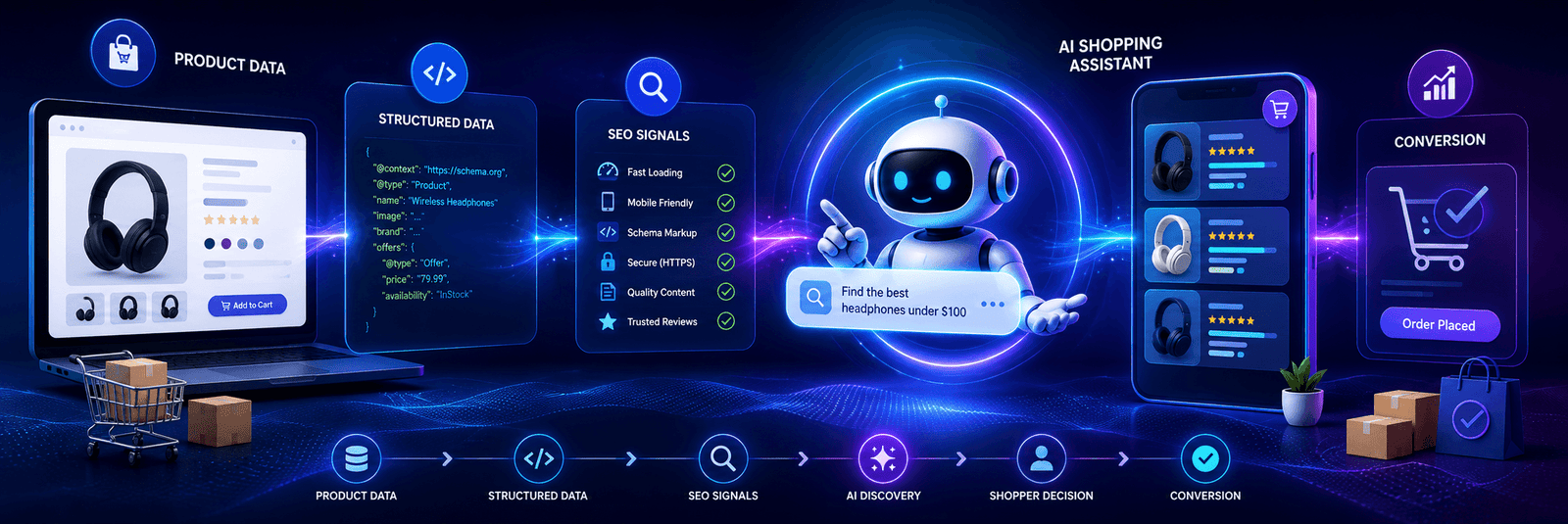
It is still developing, but the direction is clear. Ecommerce stores are no longer being discovered only by humans typing keywords into Google. They are also being evaluated by AI systems that read product data, compare details, and decide which products are relevant enough to show.
For ecommerce brands, this creates both a challenge and an opportunity.
If your product information is clear, structured, accurate, and easy to access, AI agents may understand your store better. If your product pages are vague, incomplete, slow, or blocked from crawlers, your products may be ignored even if they are good.
Agentic commerce is not just another buzzword. It is a shift in how online stores need to prepare for the next stage of digital shopping.
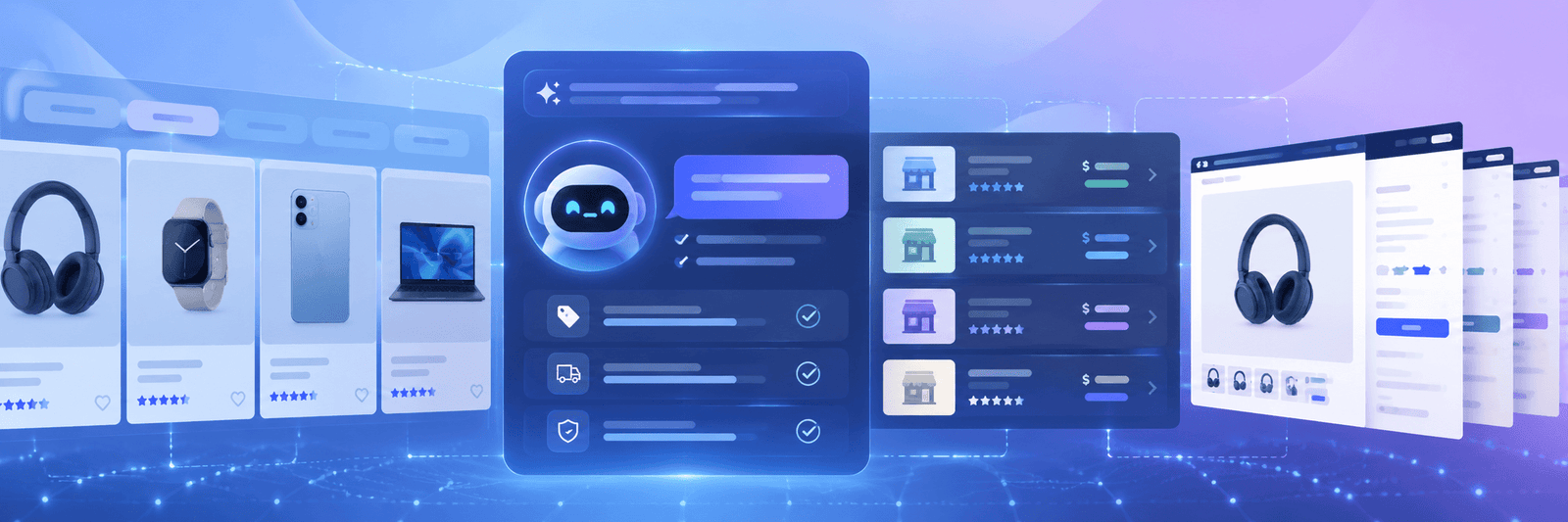
What Is Agentic Commerce?
Agentic commerce is online shopping where an AI agent helps the buyer complete part of the shopping journey.
The shopper gives the AI a goal, budget, preference, deadline, size requirement, or product need. The AI then searches for matching products, compares them, filters out unsuitable options, and may help the shopper move toward checkout.
In simple words, the AI acts like a shopping assistant.
For example, instead of opening ten websites and comparing products manually, a shopper may ask an AI assistant to find the best option. The AI may compare product dimensions, price, availability, reviews, shipping time, and suitability before recommending a few choices.
This changes the role of ecommerce websites.
Your store is no longer only speaking to human visitors. It also needs to be understandable to AI systems.
If your product page clearly explains what the product is, who it is for, what size it is, what material it uses, whether it is in stock, and when it can be delivered, an AI agent has better information to work with.
If your page is thin, confusing, or poorly structured, the AI may choose another store with clearer information.
How AI Shopping Agents Work
An AI shopping agent usually follows a simple process.
- It understands the shopper’s request.
- It searches for products that match the request.
- It compares product details against the shopper’s needs.
- It filters options based on price, availability, quality, delivery, and relevance.
- It recommends products or sends the shopper to a store to complete the order.
For example, if a customer asks for a “small coffee grinder that fits a 14-inch counter,” the AI needs product dimensions. If your product page does not mention dimensions clearly, your product may not be selected.
If another store lists the product size, stock status, price, delivery time, and customer reviews clearly, the AI has more confidence in that result.
This is the main lesson for store owners:
AI agents recommend what they can understand.
Why Agentic Commerce Matters for Ecommerce Stores
Agentic commerce matters because it changes product discovery.
Earlier, customers searched, clicked, and compared. Now, AI tools can help with the comparison before the customer even reaches your website.
This means ecommerce stores need to compete on clarity, not just keywords.
An AI assistant may compare multiple stores selling similar products. It may look at:
- Product relevance
- Price
- Availability
- Product specifications
- Shipping details
- Return policy
- Reviews
- Seller reliability
- Structured product data
If your store gives better answers, it has a better chance of being included in the recommendation journey.
This does not mean traditional SEO is dead. It means SEO is expanding.
Ecommerce SEO now needs to support human search, AI search, product feeds, structured data, and clear content.
If your store needs help preparing for this shift, Zeroradius offers ecommerce store development services focused on structure, performance, user experience, and conversion.
Agentic Commerce Is Not Only for Big Brands
Many small businesses may feel worried when they hear about AI-powered shopping.
They may think large brands will always win because they have more products, bigger budgets, and stronger name recognition.
That is not always true.
Agentic commerce can also help smaller ecommerce stores if their product data is better organized.
A small store with clear product titles, detailed descriptions, accurate stock, useful specifications, good images, fast pages, and transparent policies may be easier for an AI agent to understand than a large store with messy product data.
This is good news for independent stores.
You do not need to become the biggest brand. You need to become clear, trustworthy, and easy to read.
What Ecommerce Stores Need to Prepare
Preparing for agentic commerce does not always mean adding complex AI tools to your store.
The first step is simpler.
Make your product catalog easier to understand.
That means improving the information that both humans and AI systems rely on.
Here are the most important areas to focus on.
1. Write Clear Product Titles
A product title should explain what the product is.
Many stores use creative or brand-heavy names that sound nice but do not explain the product clearly.
For example:
Weak title: AeroFlex Pro
Better title: AeroFlex Pro Lightweight Running Shoes for Daily Training
The better title gives more context.
It tells the customer and the AI system what the product is and who it may suit.
A good product title can include:
- Product name
- Product type
- Main feature
- Use case
- Important size or model detail where useful
Do not stuff keywords. Keep it readable.
2. Improve Product Descriptions
Product descriptions should not be vague.
A good description should explain what the product does, who it is for, and why it is useful.
Many ecommerce descriptions sound like this:
This premium product is designed with high-quality materials and modern style.
This does not say much.
A better description would be:
This compact desk lamp is designed for small workspaces, with adjustable brightness, a flexible neck, and a stable base that fits easily beside a laptop or notebook.
The second version gives useful information.
It helps the customer decide. It also gives AI systems clearer product context.
If you use AI to write product descriptions, edit them manually. Add real product details, use cases, dimensions, care instructions, material information, and customer-focused benefits.
3. Add Structured Product Data
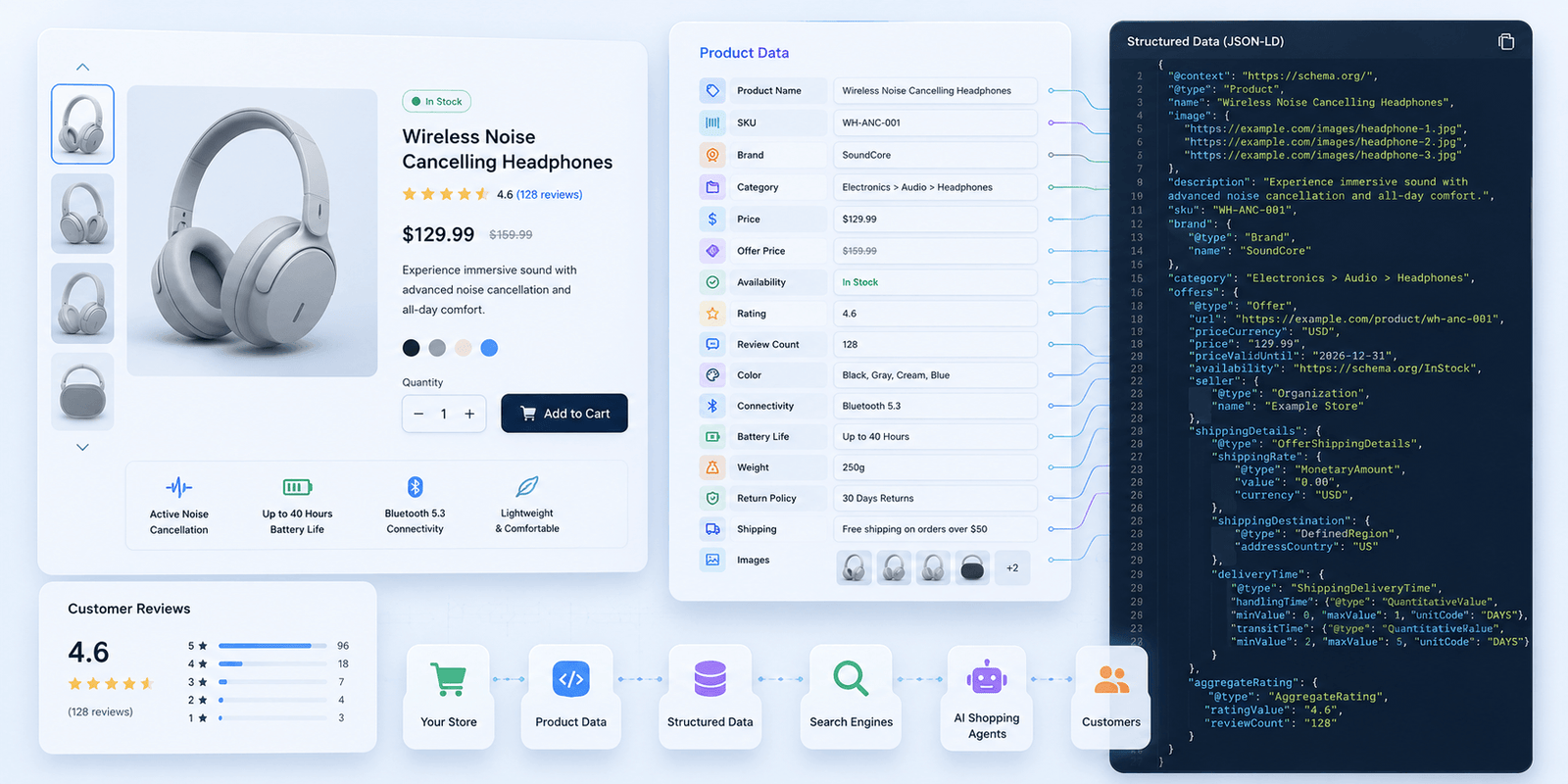
Structured data helps search engines and AI systems understand product information more clearly.
For ecommerce stores, structured data can include:
- Product name
- Price
- Availability
- Brand
- SKU
- Ratings
- Reviews
- Images
- Product category
- Shipping or offer information where applicable
This information should not be buried only inside long paragraphs.
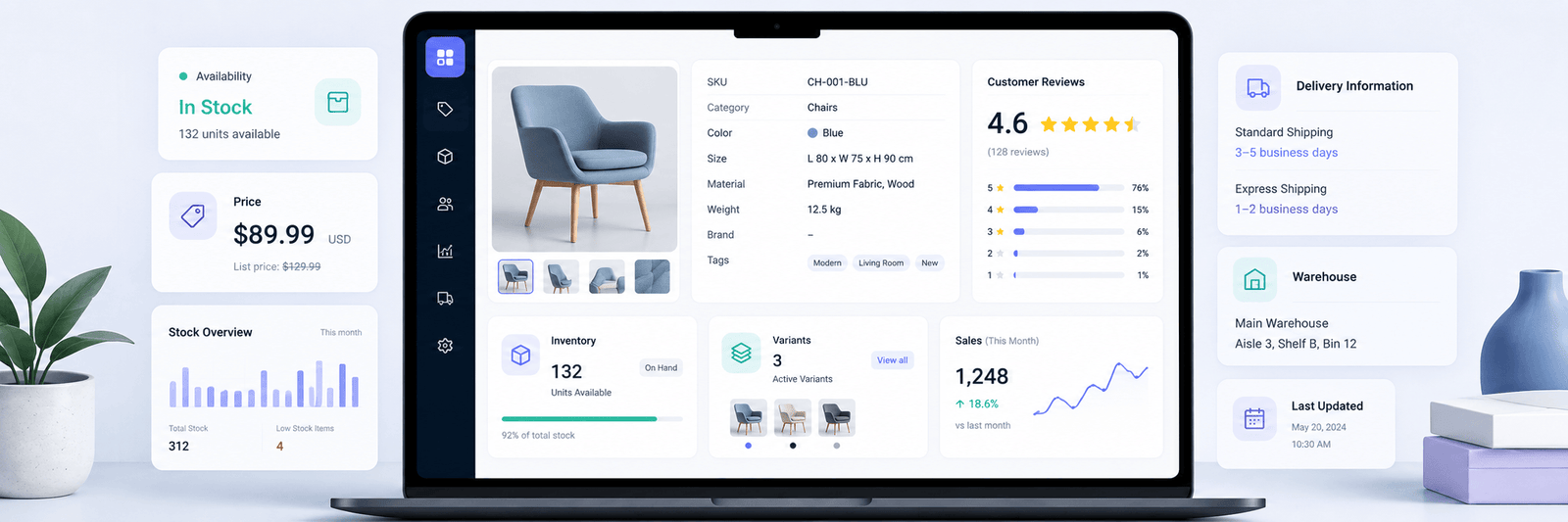
For example, if you sell furniture, dimensions should be in a proper field or table. If you sell clothing, sizes, colors, material, and fit details should be easy to identify.
Structured data helps AI agents compare products more cleanly.
4. Keep Stock and Pricing Accurate
AI shopping agents may compare products based on availability and price.
If your store shows outdated stock or unclear pricing, it creates friction.
No shopper wants to click a recommended product only to find that it is unavailable.
Keep product availability accurate.
Make sure:
- Out-of-stock products are clearly marked
- Variants show correct availability
- Discounts are displayed properly
- Shipping costs are not hidden
- Product pricing is consistent across feeds and pages
Accurate information builds trust with both customers and AI systems.
5. Make Shipping Details Easy to Find
Shipping can influence whether an AI agent recommends your product.
If the shopper asks for “delivery by Friday,” the AI needs delivery information.
If your store does not provide clear delivery details, your product may be skipped.
Helpful shipping details include:
- Estimated delivery time
- Shipping cost
- Free shipping rules
- Delivery locations
- Tracking availability
- Return policy
Add this information to product pages, cart pages, shipping policy pages, and FAQ sections.
Do not make users search too hard.
6. Use Clear Product Attributes
Product attributes are very important in agentic commerce.
An AI agent may need to know whether a product is washable, waterproof, compact, compatible with a device, suitable for kids, made from cotton, or available in a specific size.
Attributes make this easier.
Examples of useful product attributes include:
- Size
- Weight
- Dimensions
- Material
- Color
- Capacity
- Compatibility
- Age range
- Use case
- Care instructions
- Warranty
The more clearly your product attributes are organized, the easier it becomes for AI agents to compare your products with others.
7. Make Your Store Easy for Crawlers to Access
AI systems and search engines need to access your store content to understand it.
If important product pages are blocked, hidden, or difficult to crawl, your products may not appear in AI-assisted discovery.
Check your technical setup.
Review:
- Robots.txt settings
- Indexing status
- Sitemap quality
- Product page crawlability
- Blocked scripts or resources
- Canonical URLs
- Duplicate product URLs
- Structured data errors
This is where technical SEO becomes important.
A store can have good products but still be hard for AI systems to read if the technical setup is poor.
8. Improve Product Images and Alt Text
Images still matter.
AI systems may rely on product images, visual context, alt text, and surrounding content to understand products better.
Use clear product images from multiple angles.
Also add useful alt text.
Instead of:
product image
Write:
black wireless headphones with cushioned ear cups and foldable design
Good alt text helps accessibility, search, and product understanding.
Do not stuff keywords into alt text. Describe the image naturally.
9. Strengthen Trust Signals
AI may bring users to your store, but humans still need to trust you before buying.
Trust signals are important in agentic commerce because shoppers may discover new stores through AI recommendations.
If a customer has never heard of your brand, they will look for proof.
Add trust signals such as:
- Customer reviews
- Return policy
- Shipping policy
- Secure payment options
- About page
- Contact details
- Business address where relevant
- Case studies or testimonials
- Warranty information
- Support details
A clear, trustworthy store has a better chance of converting AI-driven visitors.
10. Prepare Different Ecommerce Platforms Properly
Agentic commerce preparation depends partly on your ecommerce platform.
WooCommerce, Shopify, BigCommerce, and custom ecommerce stores can all prepare, but the implementation may differ.
For WooCommerce stores, product attributes, schema, and WordPress content flexibility can be useful.
If you are using WooCommerce, Zeroradius provides WooCommerce website development services to help businesses build flexible ecommerce websites.
For Shopify stores, product data, collections, product metafields, app setup, theme quality, and speed are important. You can explore Zeroradius’ Shopify website development services if you want to improve your Shopify store structure.
For BigCommerce stores, product catalog structure, B2B features, storefront setup, and product data organization are important. Zeroradius also offers BigCommerce website development services for growing ecommerce brands.
Agentic Commerce and SEO: What Changes?
SEO is not disappearing.
But ecommerce SEO is becoming broader.
Earlier, many stores focused on keywords, category pages, product descriptions, backlinks, and technical SEO.
Those still matter.
But now stores also need to think about AI readability.
This includes:
- Clear product data
- Structured schema
- Accurate availability
- Helpful product attributes
- Strong category structure
- Natural product descriptions
- Readable policies
- Crawler accessibility
- Trust signals
Your store should answer both human questions and machine-readable comparison needs.
You can also read Zeroradius’ article on how AI search is changing SEO for a broader view of this shift.
Common Mistakes Stores Should Avoid
Many ecommerce stores may lose visibility in AI-driven shopping because of avoidable mistakes.
Common issues include:
- Vague product titles
- Copied product descriptions
- Missing product attributes
- No structured data
- Outdated stock information
- Unclear shipping details
- Poor mobile experience
- Slow product pages
- Blocked crawlers
- Missing reviews
- Weak trust signals
These issues do not only affect AI commerce. They also affect normal SEO and customer conversion.
That is why preparing for agentic commerce is not separate from ecommerce optimization.
It is part of building a better online store.
How Small Stores Can Win in Agentic Commerce
Small stores should not try to compete only on size.
They can compete on clarity, specialization, trust, and better product information.
For example, a small store selling handmade workspace accessories can provide:
- Detailed dimensions
- Material information
- Use-case descriptions
- Care instructions
- Real product photos
- Customer reviews
- Clear shipping timelines
- Founder story
This kind of detail can help both humans and AI agents understand the product better.
Large marketplaces may have scale, but smaller stores can often create better product detail and a stronger brand story.
How to Start Preparing Today
You do not need to rebuild your entire store immediately.
Start with your most important products.
Choose your top-selling or highest-margin products and improve them first.
For each product, check:
- Is the title clear?
- Is the description useful?
- Are dimensions and specifications added?
- Is stock status accurate?
- Are shipping details visible?
- Are reviews present?
- Is structured data working?
- Are images clear?
- Is the page fast?
- Is the page easy to crawl?
Then improve category pages, policies, internal links, and technical SEO.
Step by step, your store becomes more ready for AI-driven discovery.
Final Thoughts
Agentic commerce is changing how people discover and buy products online.
AI shopping agents can help customers find, compare, and choose products faster. But they can only recommend products they can understand.
For ecommerce stores, this means product clarity is becoming more important than ever.
Your product titles, descriptions, attributes, schema, stock status, shipping details, reviews, images, and technical accessibility all matter.
The stores that prepare early will have an advantage.
They will not only be easier for AI agents to read. They will also be easier for real customers to trust and buy from.
Agentic commerce is not just about AI. It is about better ecommerce fundamentals.
If your ecommerce store needs to be prepared for AI search, agentic commerce, and better customer conversion, Zeroradius can help you improve your store structure, product pages, technical SEO, and ecommerce experience.
Contact Zeroradius to discuss your ecommerce optimization plan.
FAQ
What is agentic commerce?
Agentic commerce is online shopping where an AI agent helps the shopper find, compare, and sometimes move toward purchasing products based on the shopper’s goals and preferences.
How does agentic commerce affect ecommerce stores?
It changes product discovery. Stores need clear product data, structured information, accurate stock, readable policies, and strong trust signals so AI agents can understand and recommend products.
Can small ecommerce stores benefit from agentic commerce?
Yes. Small stores can benefit if they provide clear product details, accurate availability, useful descriptions, strong reviews, and trustworthy shopping experiences.
Is agentic commerce the same as AI search?
They are related, but not exactly the same. AI search helps users find information, while agentic commerce focuses on helping shoppers compare and buy products.
What should I do first to prepare my store?
Start by improving your most important product pages. Add clear titles, useful descriptions, product attributes, dimensions, stock status, shipping information, reviews, and structured data.
Does structured data matter for agentic commerce?
Yes. Structured data helps AI systems and search engines understand product information such as price, availability, ratings, images, brand, and product details.
Will AI agents replace normal ecommerce websites?
No. AI agents may influence discovery and comparison, but ecommerce websites still matter for trust, checkout, customer support, brand experience, and direct sales.
```