
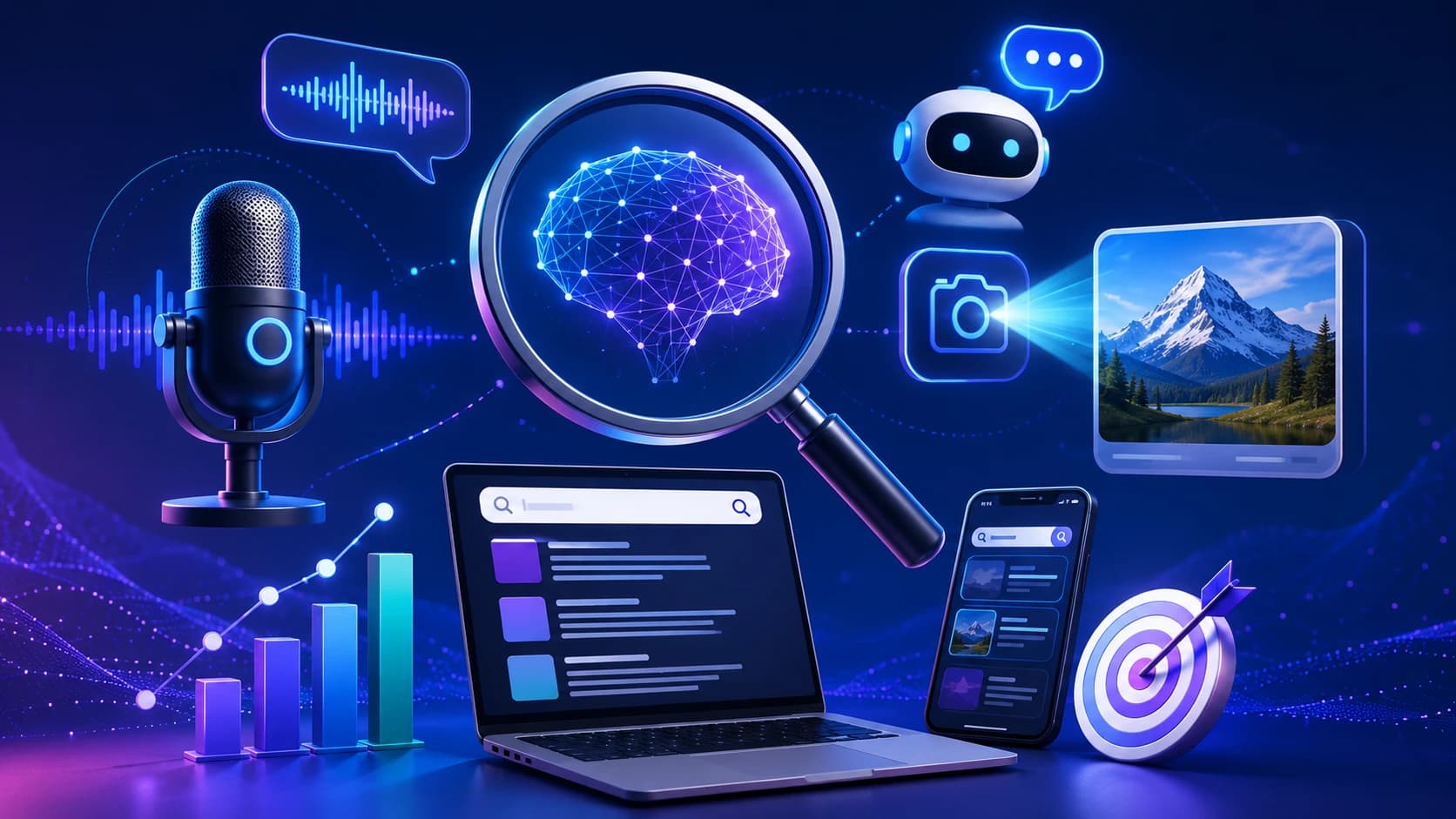
Search is no longer happening in one format. A potential customer might type a query into Google, ask a voice assistant a follow-up question, use Google Lens to identify a product, and then ask ChatGPT or Gemini for a shortlist of providers. That means modern SEO has to work across text, voice, images, and AI-generated answers instead of relying only on traditional rankings.
This is where multimodal SEO matters. It is the practice of making your website easy to understand in every major discovery environment, including search engines, AI tools, voice interfaces, and visual search systems. In practical terms, that means your content needs to be technically strong, clearly written, visually well presented, and supported by the kinds of trust signals that both users and machines can interpret with confidence.
What Multimodal SEO Really Means
Multimodal SEO is simply SEO adapted to the way people actually search in 2026. Instead of assuming that every search begins with a typed keyword, it accounts for different user behaviors and different machine interfaces. A typed search might be short and transactional. A voice query is usually conversational. A visual search depends on images, surrounding context, and product data. An AI search prompt often blends research, comparison, and recommendation into a single interaction.
A customer might type "best ecommerce development company," ask "Which company can build an online store near me?", upload a product image to find similar items, or prompt an AI tool with "Recommend a reliable agency for Shopify website development." Each of those behaviors is different, but they are all pointing toward the same business goal: being found by the right person at the right moment.
Want to turn rankings into revenue?
Build an SEO plan around the right next fix.
Get practical guidance on technical SEO, content structure, recovery work, and AI-search visibility for your website.
Why It Matters More Now
Search platforms are no longer just directories. They are interpreters. Google AI Overviews summarize. Perplexity compares. ChatGPT and Gemini recommend. Visual search tools identify and match. Voice assistants compress queries into quick spoken answers. If your website is difficult to crawl, poorly structured, vague, or visually weak, it becomes much harder to surface consistently across those systems.
A strong multimodal strategy improves visibility in standard search results, gives your pages a better chance of being referenced in AI-generated answers, helps your images appear in discovery workflows, and supports better engagement once users arrive. If your business is investing seriously in search growth, our digital marketing and SEO services are built around exactly that kind of modern visibility.
Start with Traditional SEO, Then Expand
Multimodal SEO still begins with the basics. If your site has weak structure, slow loading pages, unclear metadata, thin internal linking, or poor mobile usability, the more advanced parts of the strategy will not carry much weight. AI tools and search engines still rely on strong foundations to crawl, index, interpret, and trust your content.
The fundamentals are familiar but non-negotiable: clean URLs, useful title tags, strong heading hierarchy, clear topical organization, fast page speed, image optimization, structured data, and genuinely helpful content. Once those pieces are stable, you can extend the same page into voice-friendly, visual, and AI-readable formats much more effectively.
How to Improve AI Search Visibility
AI search tools tend to reward pages that answer real questions clearly and do it with enough depth to feel trustworthy. They are not looking only for keywords. They are looking for a page that appears reliable, easy to summarize, and aligned with the user's actual intent. That usually means direct headings, short opening answers, supporting explanation, internal links to related context, and evidence that the source knows what it is talking about.
A service page that only says "We offer ecommerce development" gives AI systems very little to work with. A page that explains platform differences, pricing considerations, migration risks, UX implications, and performance expectations is much more useful. If you offer store builds or platform work, linking that context to your eCommerce website development services page creates a more complete content trail for both users and search systems.
Write for Conversational Search, Not Just Keywords
Voice search and AI search behave more like a conversation than a keyword lookup. People do not always say "Shopify development services." They ask, "Who can help me build a Shopify store for my business?" or "What is the best ecommerce platform for a small company?" Your content needs to reflect that shift by sounding more like a helpful expert and less like a keyword list.
This does not mean abandoning SEO discipline. It means broadening it. Use natural phrasing, answer common pre-sales questions, add useful FAQs where they genuinely help, and create guides that solve the problem behind the query rather than repeating the query itself. Strong conversational content usually performs better because it is easier for people to read and easier for AI systems to summarize.
Voice Search Is Usually About Speed, Clarity, and Intent
Voice search often comes with urgency. People ask for a nearby service, a quick comparison, a fast answer, or an immediate recommendation. That is why concise answers, strong local relevance, and quick-loading pages matter so much here. The best voice-search content is not flashy. It is direct.
Businesses that depend on regional discovery should pay particular attention to local landing pages, Google Business Profile quality, accurate contact information, and local business schema. These details do more than support local SEO. They improve the likelihood that a voice interface can confidently surface your business in a time-sensitive moment.
Visual Search Depends on More Than Nice Images
Visual search is especially important for ecommerce, interiors, fashion, furniture, product catalogs, and any business where appearance heavily influences decision-making. But simply uploading attractive images is not enough. Search systems need context around those images to understand what they show, how they relate to the page, and whether they are useful to the person searching.
That means using descriptive filenames, accurate alt text, clean product data, and surrounding copy that reinforces what the image represents. Original imagery also helps because it gives your pages more distinct value than a library of generic stock assets. If your store or service pages need stronger visual presentation, our web design and UI/UX services can help improve that layer of the experience.
Structured Data Helps Machines Read the Page More Confidently
Structured data does not create quality by itself, but it reduces ambiguity. It tells search engines and AI systems whether a page is an article, a service, a product, an FAQ, a review set, a local business, or something else entirely. That extra clarity becomes more valuable as search experiences become more machine-interpreted.
For multimodal visibility, the most useful schema types often include organization, local business, service, product, article, FAQ, breadcrumb, image, review, and sometimes video. The right combination depends on the page, but the underlying goal stays the same: make it easier for a system to understand what this page is, who it belongs to, and why it should be trusted.
Multimedia Content Strengthens Discovery
Multimodal SEO is not limited to written pages. Explainer videos, product demos, before-and-after visuals, short educational clips, infographics, and process graphics can all expand the ways a user discovers your brand. They also create more assets that can appear in search, social, recommendation systems, and AI-assisted browsing.
The important point is that every asset should be treated like content, not decoration. A video needs a clear title, summary, and transcript where possible. An infographic needs context on the page. A gallery needs relevant captions. The more clearly each asset is explained, the more useful it becomes beyond simple page design.
Local SEO Still Plays a Big Role
Many voice and AI searches still carry location intent, even when the prompt sounds broad. A user may ask for an ecommerce agency, a web design partner, or an SEO team and still expect a recommendation that matches a region or service area. That is why local relevance remains important inside a multimodal strategy.
Businesses should make sure location pages are genuinely useful, not thin duplicates. Keep business details consistent, collect real reviews, describe service areas clearly, and align local pages with real customer needs. When location intent is present, this kind of specificity often makes the difference between being considered and being ignored.
Trust Signals Influence Every Search Format
Whether a page is surfaced in a traditional result, a voice response, an AI-generated summary, or a product recommendation, trust still shapes the outcome. Reviews, testimonials, case studies, author details, transparent contact information, and clear business identity all help strengthen that confidence. Search systems are increasingly cautious about recommending vague or low-confidence sources.
This is why multimodal SEO is not just a technical exercise. It is also a credibility exercise. A site that looks established and specific has a much easier time earning visibility across new discovery channels than a site that feels generic or anonymous.
Topic Clusters Make the Strategy Stronger
One of the best ways to support multimodal SEO is by building connected topic clusters around your core services. If ecommerce development is a primary service, then supporting pages on Shopify development, WooCommerce strategy, product page optimization, conversion rate improvement, checkout UX, page speed, and ecommerce SEO all reinforce the same area of expertise.
Related pages should link to one another where the connection is useful. Clear paths between relevant guidance make it easier for readers and AI systems to understand the breadth and depth of your expertise.
Measure More Than Rankings
A multimodal strategy should not be judged by keyword positions alone. The more useful measurements are broader: organic traffic quality, image-search engagement, branded-search growth, Search Console performance, visibility on local queries, conversions from organic visitors, and signs that your brand is being cited or discovered in AI-assisted workflows.
Some of these signals are imperfect and not every channel reports neatly, but the pattern matters. If your content is reaching the right audience more often and driving stronger engagement, the strategy is moving in the right direction.
A Practical Multimodal SEO Checklist
- Strengthen technical SEO and page speed before expanding into newer formats.
- Write pages that answer questions clearly, not just pages that target keywords.
- Improve image quality, alt text, filenames, and contextual relevance.
- Use structured data to clarify page purpose and business identity.
- Build real trust signals through reviews, case studies, and transparency.
- Create cluster content that reinforces your core areas of expertise.
- Track visibility and performance across multiple search behaviors, not only rankings.
Have questions?
Multimodal SEO is the practice of optimizing content for different search behaviors and interfaces, including typed search, voice search, visual search, and AI-generated answers.
Because people now discover brands in more ways than traditional Google listings alone. A business needs to be understandable across search engines, AI tools, and visual or voice-driven interfaces.
Focus on concise answers, natural language, local relevance, fast loading speed, accurate business details, and FAQ-style content where it adds real value.
Use clear original imagery, accurate alt text, descriptive filenames, product or image schema where relevant, and surrounding content that explains what the visual represents.
No. Traditional SEO remains the foundation. AI visibility usually improves when the core technical, structural, and content fundamentals are already strong.
Content that is clear, well structured, experience-based, and easy to summarize tends to perform best, especially when it also includes strong trust signals and internal context. Final Thoughts The future of search is not one channel replacing another. It is multiple channels overlapping. Businesses that adapt well will be the ones that make their expertise easy to find, easy to trust, and easy to understand whether a user is typing, speaking, scanning, or asking an AI tool for help. Multimodal SEO is ultimately about meeting people where they search now. When your technical foundation, content quality, visual clarity, and trust signals all work together, your brand becomes much more discoverable in the environments that matter most.