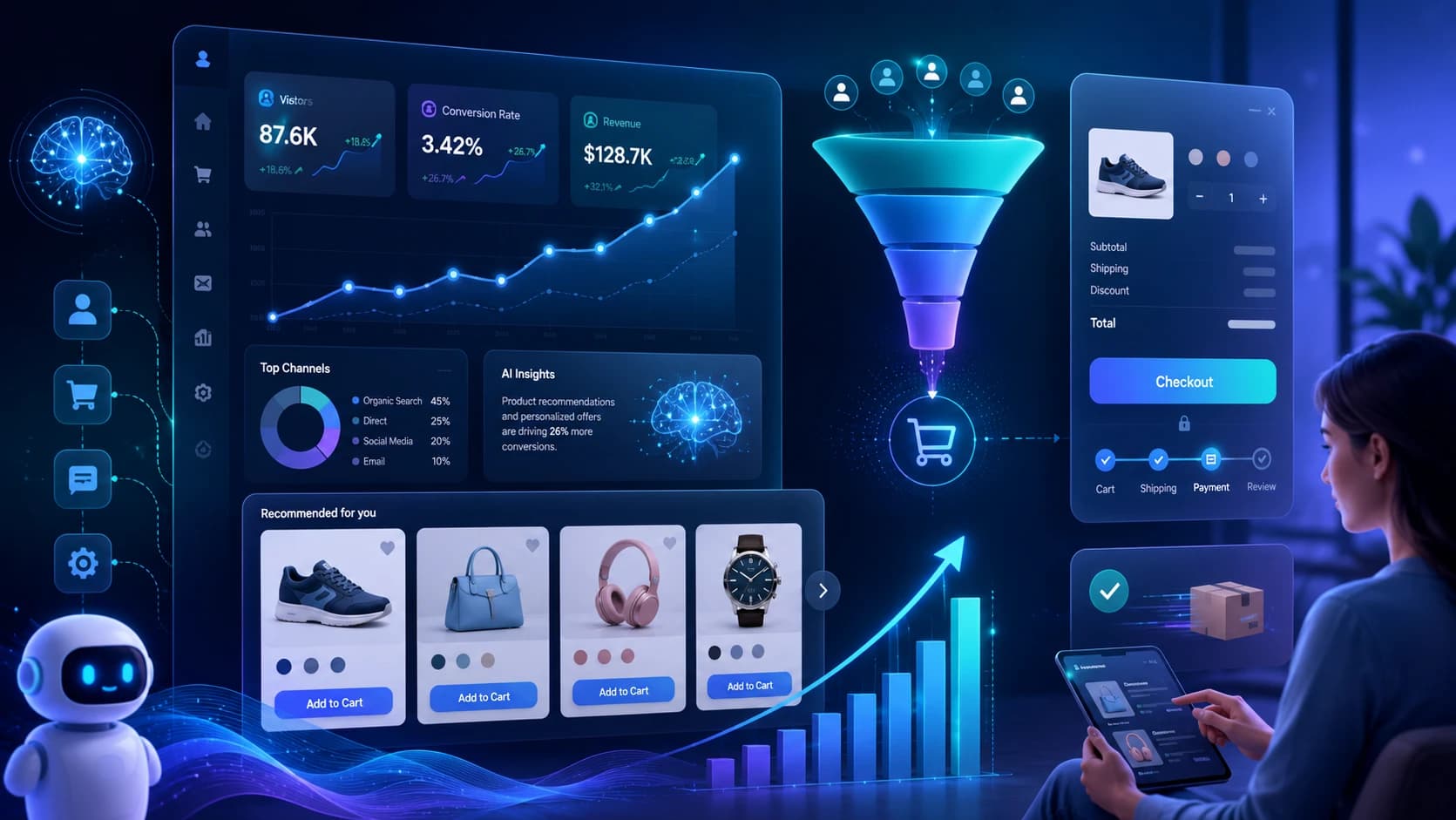
Many ecommerce businesses assume their growth problem starts with traffic, but that is not always true. Plenty of stores already attract visitors and still struggle to turn enough of them into buyers. In those cases, the real issue is usually friction somewhere in the journey: the wrong products are being shown, the page does not answer buyer questions clearly enough, support is too slow, or the store is not adapting well to different types of shoppers.
This is where AI becomes commercially useful. It helps stores respond more intelligently to customer behavior instead of treating every visitor the same. That can mean more relevant product recommendations, better-timed messaging, faster support, stronger search behavior, and better analysis of where people hesitate. AI does not improve conversions because it sounds advanced. It improves conversions when it helps the store become more relevant and easier to use.
The key is to see AI as a decision-support layer, not a shortcut around customer understanding. The stores that benefit most are usually the ones already trying to remove friction carefully and improve the buying experience step by step.
Personalization Is One of the Clearest Wins
One of the strongest reasons AI helps conversion is that it makes personalization more practical at scale. A returning customer should not always see the same experience as a first-time visitor. A shopper who spends time in one category should not be shown generic options everywhere else. AI helps interpret those signals and respond with more relevant recommendations, product blocks, offers, and follow-up messaging.
The best personalization feels useful rather than intrusive. It helps the customer get to the right product or next action faster. When relevance improves, hesitation often drops with it.
Product Discovery Becomes More Intelligent
Many lost sales begin with weak discovery. If users cannot find the right product quickly, they often leave before they ever reach the point of serious consideration. AI helps here by improving search behavior, recommendation logic, filtering, and how the store responds to different browsing patterns. That matters especially for stores with larger catalogs, where simple keyword matching or static merchandising often falls short.
Our guide on Shopify Search & Discovery optimization connects well with this problem because better product discovery is often one of the fastest ways to improve commercial performance.
AI Chatbots Can Reduce Decision Friction
Support speed has a direct relationship with conversion, especially when the customer is close to buying but still has one or two unresolved questions. AI chatbots help by answering common questions immediately, guiding users toward relevant products, and keeping momentum alive outside normal support hours. The value is not just efficiency for the business. It is confidence for the shopper.
That works best when the chatbot is genuinely helpful. If it traps customers in shallow answers or avoids escalation when a human is needed, it creates more friction than it removes. Our article on building an AI chatbot for ecommerce goes deeper into that setup.
Testing and Optimization Get Faster
Conversion improvement depends on experimentation, but many teams do not test enough because producing good variations takes time. AI lowers that barrier. It can help generate alternate headlines, CTA language, email variants, recommendation strategies, and product-page framing much more quickly than a fully manual process.
That speed matters because it gives the business more chances to learn. The point is not endless experimentation for its own sake. It is faster insight into what actually reduces hesitation for your audience.
Analytics Become More Actionable
Most stores already have conversion data, but data alone does not improve sales. Teams often know their bounce rate, add-to-cart rate, or checkout completion rate, yet still struggle to decide what to fix first. AI is useful here because it can help interpret patterns, summarize likely problem areas, and prioritize opportunities more quickly.
Better prioritization is one of the most underrated benefits of AI in ecommerce. It helps the team spend attention on the parts of the journey most likely to influence revenue instead of spreading effort too evenly across the entire store.
Store Performance Still Matters
AI does not make technical quality irrelevant. If the store is slow, cluttered, or hard to use on mobile, personalization alone will not solve the problem. In many cases, AI works best when layered onto a strong foundation that already includes good UX, clear product content, and reliable performance.
This is why conversion improvement often overlaps with broader site-quality work. Our Core Web Vitals guide and Shopify speed article are useful related reads if performance is part of the issue.
Common Mistakes to Avoid
The most common AI mistakes in conversion work are over-automation, generic messaging, poor-quality chatbot experiences, and assuming that more tooling automatically means better results. AI is most effective when it sharpens relevance and reduces friction. It becomes far less useful when it simply adds more automated output to a weak store experience.
Want to turn rankings into revenue?
Build an SEO plan around the right next fix.
Get practical guidance on technical SEO, content structure, recovery work, and AI-search visibility for your website.
Final Thoughts
AI helps ecommerce stores improve conversion rates because it makes the customer journey more responsive. It can personalize better, support faster decisions, improve discovery, and help teams optimize more intelligently. Those gains are practical, not theoretical.
The strongest results usually come when AI is supporting a store that already cares about clarity, trust, and usability. In that setting, it becomes a real growth tool rather than just another feature to install.
Have questions?
It improves conversion by making the store more relevant and easier to use through personalization, better support, stronger discovery, faster testing, and better interpretation of customer behavior.
Yes. It can help by answering last-minute questions, personalizing reminders, improving product recommendations, and reducing friction before checkout.
Yes. Smaller teams often benefit a lot because AI can reduce repetitive work while helping them deliver a more structured customer experience.
No. It supports conversion work, but human judgment is still needed to decide what fits the customer, the brand, and the wider business model.