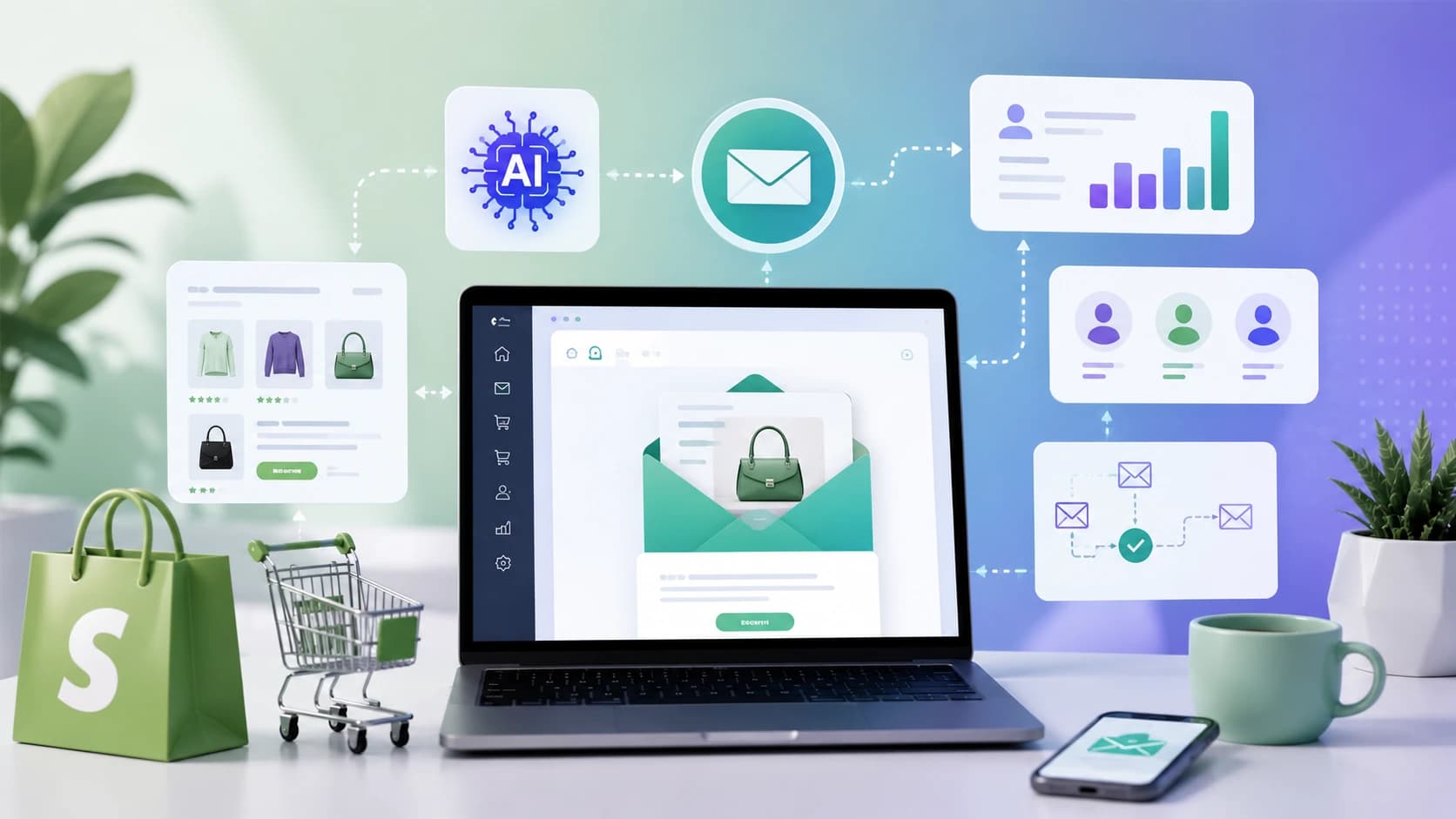
Email remains one of the most valuable channels in ecommerce because it reaches people who have already shown some level of interest in the brand. Unlike paid ads, it is not borrowed attention. Unlike search, it is not always dependent on someone discovering you at the right moment. Email lets a Shopify store keep the relationship going after the first visit, the first purchase, or even the first abandoned cart.
The difficulty is not understanding that email matters. The difficulty is running it well at scale. Writing campaigns consistently, segmenting intelligently, creating variation without sounding repetitive, and improving performance over time all take work. This is where AI can become genuinely useful.
The strongest use of AI in Shopify email marketing is not as a replacement for strategy. It is as a force multiplier for teams that already understand their customer journey and want to execute more intelligently.
That distinction matters because email only performs well when the store is sending the right message at the right stage of the relationship. AI can improve that execution, but it still needs a strategy worth amplifying.
Without that strategic layer, faster email production just creates more messages, not better retention. The technology is most valuable when it sharpens relevance instead of only increasing output.
Why Email Still Produces Strong ROI
Email continues to perform well because it supports both relationship-building and revenue recovery. It helps stores welcome new subscribers, bring back dormant customers, recover abandoned carts, introduce new products, support repeat purchases, and strengthen retention in ways that other channels often struggle to do as efficiently.
In Shopify, that matters because many customers do not buy the first time they visit. Email creates a second chance and often a third. It gives the business a way to stay relevant after the visitor leaves the site.
Where AI Is Most Useful in Email Marketing
AI is most valuable when it reduces repetitive effort while still allowing the brand to stay recognizable. Subject line generation, email draft creation, CTA variation, segmentation support, product recommendation framing, and testing ideas are all areas where AI can save time meaningfully.
It can also help turn customer data into more actionable messaging. Browsing behavior, purchase history, recency, category preference, and inactivity patterns can all inform campaigns more intelligently when AI is helping interpret and apply them. The point is not to automate everything for the sake of automation. It is to make each email feel more relevant without multiplying manual work endlessly.
Personalization Works Best When It Feels Useful, Not Creepy
One of the clearest advantages of AI in email marketing is personalization at scale. Done well, this makes campaigns feel more timely and more relevant. A customer who has viewed certain product categories, purchased specific items, or responded to previous promotions should not be receiving the exact same message as someone else in a completely different part of the buying journey.
The important thing is that the personalization should feel helpful rather than overly intrusive. Product reminders, replenishment suggestions, complementary recommendations, or category-based campaigns tend to work best when they align naturally with customer behavior. AI can support this well by identifying patterns faster than a team could manually, but the campaign logic still needs human judgment.
When this is handled well, the customer experience feels more relevant without becoming unsettling. The email feels timely, not invasive, which is a much better foundation for long-term retention.
AI Can Improve Copy, but It Still Needs Editorial Control
Great email copy has to earn attention quickly. Subject lines, preview text, email opening lines, and CTA wording all matter because inbox space is competitive and customer patience is limited. AI is particularly useful here because it can create multiple copy angles quickly, helping teams explore different tones, offers, and emotional hooks before choosing the strongest option.
But just like on websites, AI-generated email copy can become generic if it is used without editing. The goal is not to sound more artificial or more “salesy.” It is to sound more relevant. Subject lines should create honest curiosity. Body copy should move clearly from interest to action. The CTA should feel like a natural next step, not a hard push.
Automation Is Where the Real Leverage Appears
AI becomes especially powerful when it is tied into automation. Welcome sequences, abandoned cart flows, post-purchase follow-ups, win-back campaigns, and product launch series all become more effective when the messaging is shaped by customer behavior rather than sent as one generic broadcast.
This is where Shopify email strategy begins to feel like a growth system instead of a campaign calendar. The store can respond to actions more intelligently, send better-timed reminders, and adjust the content based on what the customer has already done. That helps retention because the emails feel more connected to the experience the shopper actually had.
Testing Gets Better When Variation Is Easier
A/B testing is another area where AI creates practical value. Subject lines, message framing, CTA language, offer presentation, and content structure can all be tested more effectively when generating meaningful variation becomes easier. This reduces the temptation to run the same style of campaign repeatedly just because it is faster to produce.
The real benefit is not that AI can produce more versions. It is that it can help the team learn faster. When patterns emerge around what your audience responds to, future campaigns become sharper rather than simply more frequent.
Good AI Email Marketing Still Needs Human Strategy
The most common mistake with AI in email marketing is expecting automation to replace marketing judgment. AI can draft, segment, test, and suggest, but it does not automatically understand brand nuance, promotional timing, customer fatigue, or the wider commercial context around a campaign.
Stores still need to decide what kind of relationship they want to build with subscribers, how often to send, what kinds of offers support margin, and where email fits in the wider acquisition and retention strategy. AI improves execution. It does not replace positioning.
This is why the best-performing AI-assisted email programs usually look more thoughtful, not merely more automated. The technology reduces repetition, but the commercial logic still comes from the team behind the store.
If your ecommerce systems are also being improved more broadly, our Shopify AI guide and UI/UX services page are useful related resources.
Common Mistakes to Avoid
AI email marketing becomes weaker when stores over-send, under-edit, or rely too much on novelty instead of relevance. Too many emails can erode trust just as quickly as too few can reduce recall. Poorly reviewed AI copy can sound polished but empty. Weak mobile formatting can reduce click-through even when the message itself is strong.
In short, AI should make email marketing smarter, not noisier.
Ready to improve your Shopify store?
Get a sharper plan for Shopify growth.
Talk through theme decisions, speed issues, merchandising, product discovery, and conversion improvements with the Zeroradius team.
Final Thoughts
AI can make Shopify email marketing more efficient, more personalized, and more adaptable, but the real value comes when it supports a strong underlying strategy. The stores that benefit most are usually the ones that already care about customer journey, segmentation, and message quality. AI simply helps them execute at a higher level.
Used well, it turns email from a repetitive manual task into a more responsive, better-performing retention system. That is where the real commercial advantage begins.
Have questions?
It can, especially when it helps create stronger subject lines and better audience targeting. But the best results usually come when AI support is paired with real testing and editorial review.
It can automate a large part of the workflow, but human oversight is still important for strategy, brand voice, segmentation logic, and campaign quality.
Yes. It can be especially valuable for smaller teams because it reduces manual effort while making campaigns feel more relevant and structured.