
AI has made Shopify builds noticeably faster, but the real value is not just speed. It is the ability to reduce repetitive work across multiple stages of the store-building process without letting quality collapse. That distinction matters because there is a big difference between a store that launches quickly and a store that launches well.
Many ecommerce teams are now using AI to help with product content, basic code generation, debugging, campaign drafts, and internal QA support. Used properly, this shortens timelines and frees up more energy for the decisions that matter most: merchandising, user experience, trust, positioning, and conversion flow. Used badly, it simply produces a store that looks complete on the surface while still feeling generic underneath.
The goal should never be to build a Shopify store with as little human thinking as possible. The goal is to move faster through the predictable work so more attention can be spent on the commercial decisions that actually affect growth.
That is usually the healthiest framing for AI inside build workflows. It should increase the time available for judgment, not reduce the role of judgment in the parts of the store that customers actually feel.
Why AI Fits Shopify So Well
Shopify already gives merchants a structured environment. Product data, collections, templates, content blocks, emails, apps, and theme logic all follow patterns. That makes it a strong fit for AI assistance because many tasks are repetitive in format even when the final brand expression should remain unique.
For example, product descriptions need consistency but not sameness. Collection pages need structure. Liquid snippets often repeat patterns. Marketing assets need frequent iteration. AI is well suited to these conditions because it reduces blank-page time and repetitive drafting time without replacing the need for human review.
Content Production Speeds Up First
The fastest visible gains usually appear in content. AI can help draft product descriptions, collection intros, FAQ content, email copy, promotional banners, and first-pass SEO metadata much faster than a manual workflow. That matters because content is one of the biggest launch bottlenecks for many Shopify stores.
But speed should not create laziness. Product copy still needs accuracy, collection pages still need search intent awareness, and every important customer-facing message still needs to sound like the brand behind it. The benefit of AI is that it gets the team to a workable draft quickly. The final lift still comes from editing, merchandising judgment, and a better understanding of what the customer needs to know before buying.
If this is a major priority for your store, our article on AI product descriptions for Shopify goes deeper into the content side of that workflow.
Theme Development and Debugging Become More Efficient
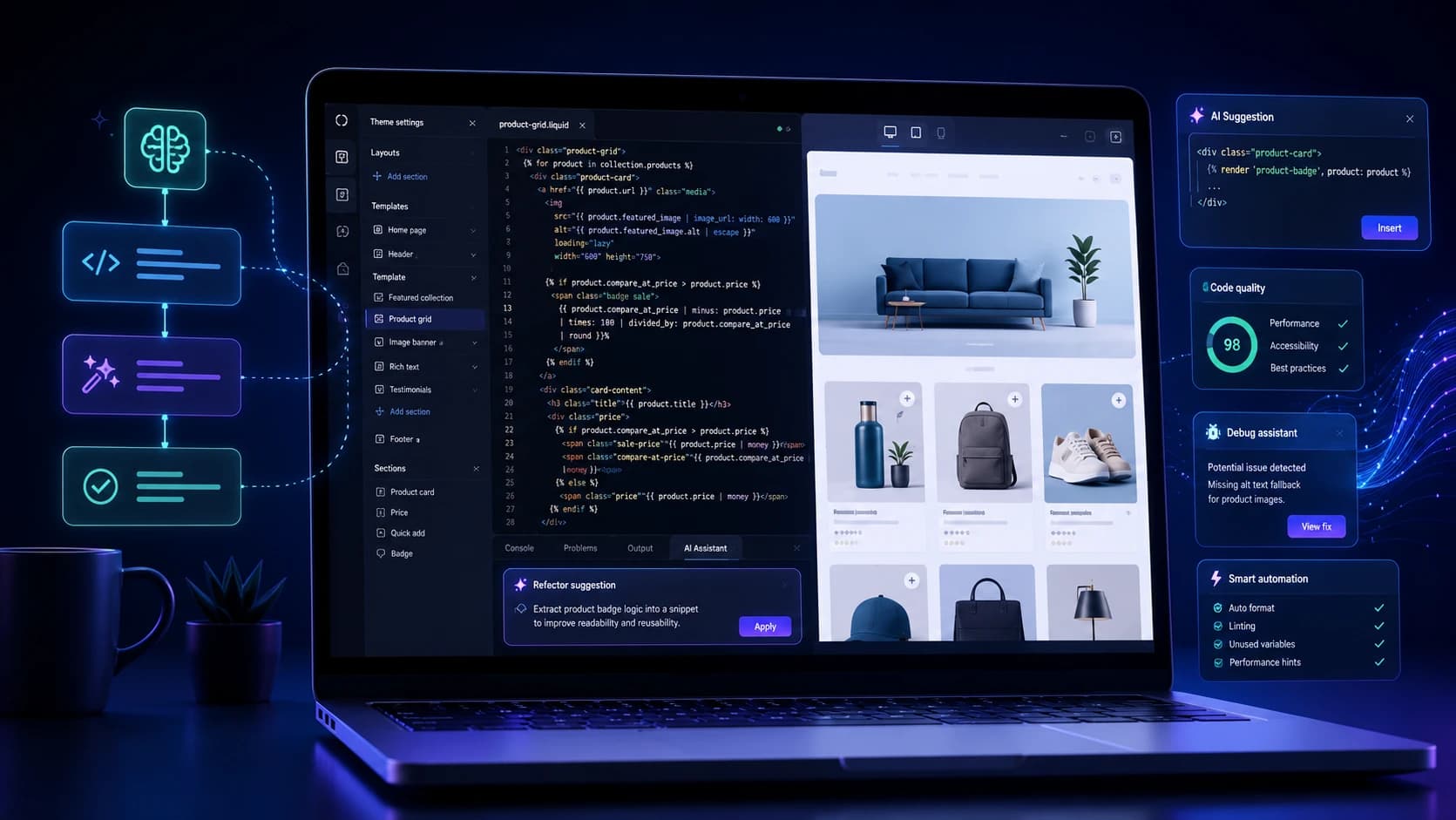
AI can also be genuinely useful in the development layer. Shopify theme work often involves repeated patterns in Liquid, schema, styling, section logic, and data output. An experienced developer can use AI to accelerate routine code generation, prototype section ideas faster, and troubleshoot common errors more quickly.
This does not mean AI replaces Shopify developers. It means a developer can spend less time on boilerplate and more time on implementation quality. That is particularly helpful when building custom sections, refining cart behavior, handling app integrations, or debugging theme issues that would otherwise slow down the project.
AI is most effective here when the person using it already understands what good output should look like. Without that judgment, fast code generation can easily create fragile code rather than strong code.
The same pattern holds across the rest of the build. AI tends to amplify the quality of the workflow it enters. In a disciplined process, it creates leverage. In a messy process, it often just helps the mess happen faster.
That is why the best AI-assisted Shopify builds usually come from teams that already have clear standards for UX, content, QA, and technical review. Speed becomes an advantage only when the baseline process is strong enough to absorb it well.
Marketing Workflows Get Lighter
Launching a Shopify store is not only a design and development exercise. It usually comes with ad copy, launch emails, promotional messaging, on-site banners, social content, and seasonal campaign preparation. AI can speed up all of this significantly by generating usable starting points across channels.
That does not mean every campaign should sound machine-polished. In fact, the stores that benefit most are usually the ones that use AI for ideation and structure, then apply stronger editorial control so the final language still feels intentional. Good marketing is not just fast output. It is alignment between product, audience, timing, and tone.
Faster Builds Only Matter If the Store Still Converts
One of the dangers of AI-led acceleration is mistaking completed tasks for real readiness. A store can have product copy, populated templates, email flows, and working pages, yet still convert weakly because the underlying customer journey has not been thought through carefully enough.
A strong Shopify store still needs clear product-page hierarchy, visible trust signals, fast mobile performance, useful search and navigation, reassuring checkout flow, and CTAs that feel easy to act on. AI can support these areas, but it cannot substitute for conversion judgment.
Our article on AI conversion optimization for Shopify is a helpful companion if your goal is not just faster launch, but stronger revenue performance after launch.
QA and Store Reviews Become Easier to Organize
Another underrated benefit of AI is that it helps teams review more systematically. It can assist with checklist creation, content gap spotting, consistency checks, draft QA notes, and identifying likely problem areas across product pages, collections, and information architecture. That does not replace human QA, but it can make the process more thorough and less chaotic.
This is especially useful for agencies and in-house teams handling multiple launches or frequent catalog updates. A cleaner workflow reduces delays and helps fewer details fall through the cracks.
That operational benefit is easy to underestimate because it is less visible than generated content or code. But in many teams, cleaner QA support is one of the most reliable ways AI shortens launch cycles without lowering standards.
The Best Teams Use AI as a System, Not a Shortcut
The stores seeing the biggest advantage from AI are usually not using it for a single flashy task. They are using it as part of a broader operating system. Product content, theme support, campaign production, SEO drafting, FAQ updates, support copy, and testing ideas all become easier when the workflow is connected.
That kind of system creates compounding gains. It does not just make one launch faster. It makes future updates, seasonal campaigns, expansion work, and optimization cycles easier as well.
Common Mistakes to Avoid
The main mistakes are predictable: publishing raw AI content, over-automating brand communication, trusting generated code without proper review, and assuming faster output automatically equals stronger performance. AI can compress time, but it cannot provide judgment on its own.
In practical terms, the right model is simple. Let AI handle more of the drafting and repetition. Let experienced people handle the positioning, review, and commercial decisions.
Ready to improve your Shopify store?
Get a sharper plan for Shopify growth.
Talk through theme decisions, speed issues, merchandising, product discovery, and conversion improvements with the Zeroradius team.
Final Thoughts
AI can absolutely help teams build Shopify stores faster, but the more useful framing is that it helps them build more efficiently. That efficiency becomes valuable when it creates room for stronger product strategy, better UX, more thoughtful messaging, and more rigorous optimization.
The fastest store is not always the best one. The stronger outcome is a store that launches with clarity, trust, and conversion intent already built into it. AI can help you get there sooner, but only if the workflow still has experienced human control.
If you need help building or improving a Shopify store with that balance in mind, Zeroradius offers Shopify website development and UI/UX services focused on performance and ecommerce growth.
Have questions?
No. AI can speed up content, coding support, and workflow tasks, but a strong store still needs human direction for strategy, branding, UX, and quality control.
Product content, first-draft marketing copy, repetitive theme tasks, debugging support, and launch workflow organization are some of the most useful areas.
It can, especially when it improves copy, personalization, testing speed, and operational efficiency, but conversion still depends on the overall store experience.