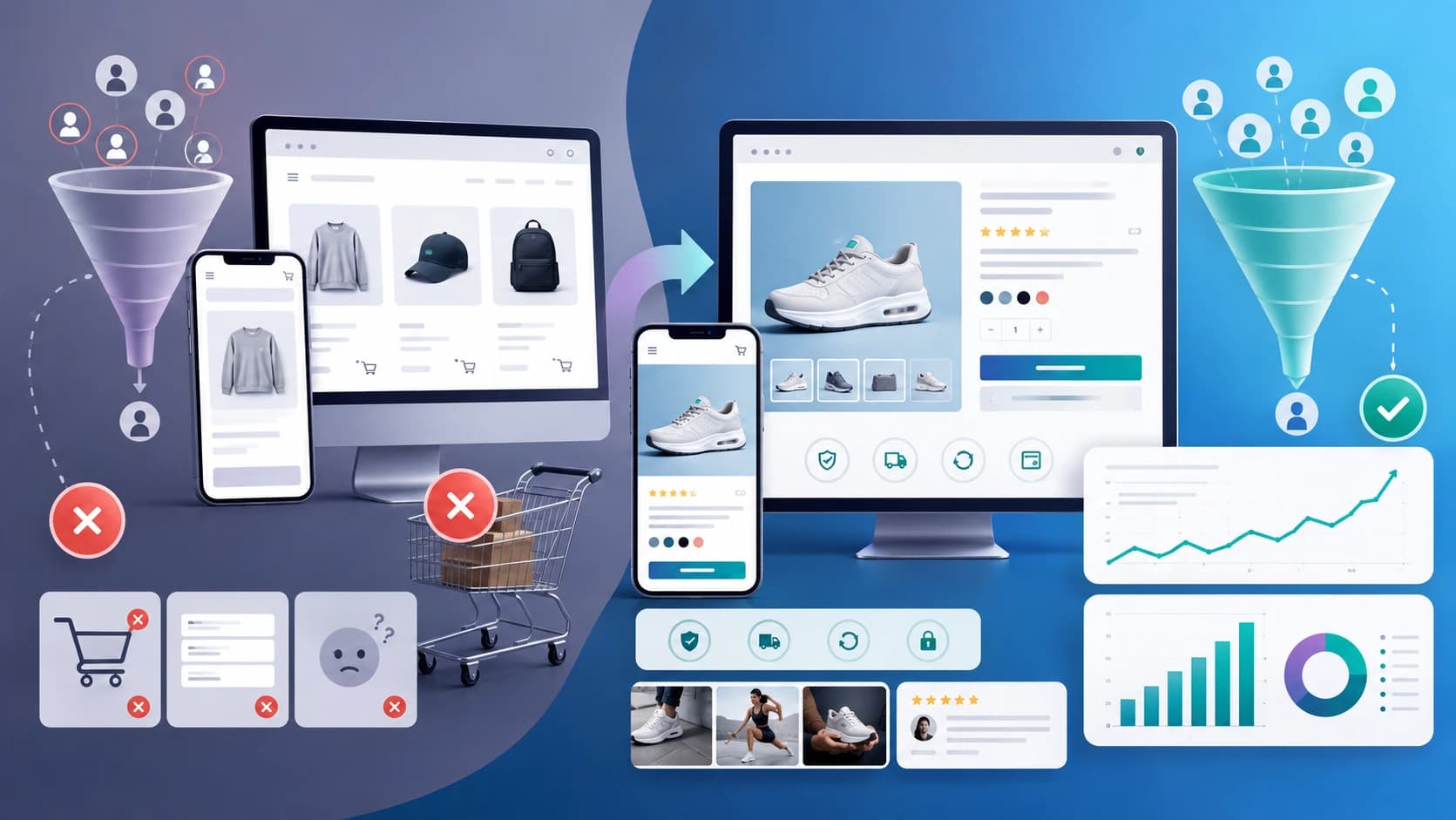

A Shopify product page has to do two jobs at once. It has to help the right customer find the product through search, and then it has to help that same customer feel confident enough to buy. Many stores only handle the first half of that problem. They think about keywords, title tags, and rankings, but the page itself does not do enough to reduce hesitation once the user arrives.
In 2026, product page SEO is not just about visibility. It is about clarity, trust, speed, and decision support. A page can rank reasonably well and still perform badly if the product information is vague, the add-to-cart experience feels weak, or the store does not look trustworthy enough to complete the sale.
The strongest product pages are the ones that feel useful before they feel persuasive. They answer real buying questions, organize detail clearly, and make the purchase path feel easier.
That is why the best product-page work usually improves both search performance and conversion quality at the same time. The same clarity that helps the page rank more appropriately often helps the customer trust it more once they arrive.
Start With Search Intent, Not Just the Keyword
A product page should reflect the reason someone is searching in the first place. Some shoppers already know the exact model they want. Others are comparing options and still deciding whether your product fits their need. Those two users require different levels of context, and a strong product page anticipates that difference.
This is why SEO on product pages should begin with intent rather than only phrase matching. What is the user trying to confirm? Are they looking for dimensions, durability, material, compatibility, delivery speed, comfort, or proof that the product solves a specific problem? The more clearly the page addresses those concerns, the stronger both its conversion potential and its SEO usefulness become.
In practical terms, this often means writing for the decision, not just for the query. A page that mirrors real buying concerns usually performs better than one that simply repeats the main keyword more often.
If your store is being structured more strategically overall, a stronger Shopify website development process can help align product pages, collection pages, and blog content more effectively from the start.
Titles Should Be Clear Before They Are Clever
A product title should help both search engines and buyers understand what the item actually is. Many stores weaken this by relying too heavily on brand-driven naming without enough descriptive context. That may feel stylish internally, but it often creates unnecessary ambiguity.
A stronger title usually includes the product type and the main distinguishing feature in a way that still feels readable. This is not about stuffing keywords. It is about removing avoidable uncertainty. A shopper should not have to interpret the title before they can decide whether the page is relevant.
Descriptions Should Help People Decide
One of the most common weaknesses in Shopify product pages is the use of thin or supplier-style descriptions. These often describe the product in generic terms without explaining why the features matter to the buyer. That creates a page that is technically filled out but commercially underpowered.
A stronger product description should connect product attributes to real use. It should explain what the item helps with, who it suits, and why someone would choose it over a similar alternative. That does not mean writing long paragraphs for the sake of length. It means making the information more useful.
AI can help draft descriptions faster, but they still need real product knowledge before publishing. If your team is using AI in this part of the workflow, our article on AI product descriptions for Shopify connects well here.
Images Should Answer Practical Questions
Good product images are not only attractive. They are informative. A customer wants to understand scale, detail, finish, usability, packaging, and how the product looks in context. That is why multiple useful images typically outperform one polished hero image on its own.
The best product galleries mix clean product presentation with context that helps the customer imagine real ownership. Lifestyle shots, close-up details, alternate angles, and in-use images often build more confidence than overly edited studio visuals alone. If relevant, packaging, size comparison, and variant-specific imagery can reduce support questions and increase trust.
Images also affect performance. Heavy product media can quietly hurt both search visibility and conversion if the page becomes slow. Our guide on how to speed up a Shopify store is a useful companion when product media is part of the performance problem.
Performance and Add-to-Cart UX Matter as Much as Content
Even a well-written product page can lose sales if the page feels slow, cluttered, or awkward to use. Too many apps, oversized media, bloated themes, and unnecessary scripts often damage the product page experience more than merchants realize. Performance is not just technical hygiene here. It shapes trust and patience.
The buying section itself should also feel clear at a glance. Price, stock status, variant selection, delivery expectations, returns context, and the add-to-cart action should be easy to understand without forcing the user to scroll through confusion first. If core purchase information is hard to find, the page creates doubt instead of momentum.
For ecommerce brands, this is one reason product-page UX and revenue are so tightly connected.
Trust Signals Deserve a Place on the Page
Product pages convert better when they make the store feel more credible. Reviews, return clarity, delivery context, warranty notes, payment reassurance, and useful support information all help reduce hesitation. The customer may be interested in the product, but interest alone is rarely enough without confidence in the store itself.
Reviews are especially valuable when they sound specific rather than generic. A practical note about fit, comfort, packaging, or delivery can do more persuasive work than vague praise. Trust is built most effectively when the page feels like it is helping the customer verify the decision, not pressuring them into it.
This also connects well with wider authority signals. Our article on trust signals for AI SEO is relevant because product credibility increasingly matters to both users and discovery systems.
For many stores, improving trust on the product page is one of the fastest ways to raise conversion quality without changing the product itself.
FAQs and Supporting Links Can Remove Friction
A good product page should anticipate the last few doubts before purchase. FAQs can help with this when they reflect real customer concerns rather than filler content. Delivery questions, fit questions, returns, compatibility, warranty, and usage details all belong naturally in FAQ form when they are truly relevant to the product.
Internal linking matters too. Product pages should not exist in isolation. Relevant collection pages, related products, comparison content, and buying guides can all help the customer continue exploring without hitting a dead end. For stores with wider catalogs, our article on optimizing Shopify Search & Discovery connects directly to that discovery layer.
Track Behavior, Not Just Rankings
Product page optimization should always return to behavior. Rankings and traffic matter, but they are only part of the picture. Add-to-cart rate, bounce rate, scroll depth, mobile engagement, and checkout progression tell you whether the page is actually doing its job.
If the page gets traffic but weak product interaction, the issue may be clarity, trust, price positioning, or weak imagery. If it gets cart activity but poor checkout completion, the issue may sit downstream in shipping, payment, or overall friction. That is why data matters. The page should be improved based on what users actually do, not only on what the team assumes they are doing.
Our article on why Shopify stores fail to convert is a useful broader read if this problem appears store-wide.
Ready to improve your Shopify store?
Get a sharper plan for Shopify growth.
Talk through theme decisions, speed issues, merchandising, product discovery, and conversion improvements with the Zeroradius team.
Final Thoughts
Great Shopify product pages are not only optimized for search. They are built to help people make better buying decisions. That means clear titles, stronger descriptions, helpful imagery, faster performance, visible trust signals, and a buying section that feels confident and easy to use.
When enough product pages improve in this way, the store usually becomes stronger as a whole. Better product-page SEO and better product-page conversion are rarely separate wins. Most of the time, they reinforce each other.
Have questions?
Focus on search intent, stronger titles, useful original descriptions, better internal linking, clear trust signals, helpful imagery, and performance that supports a good user experience.
Yes. They help search engines understand the page better and help users feel more confident about what the product is and why it matters.
Yes, when the questions reflect real buyer concerns such as delivery, fit, compatibility, returns, or usage details.
Common reasons include weak clarity, poor imagery, low trust, slow performance, hidden buying information, or friction later in the purchase path.