Choosing a website platform is one of the most important early decisions in any digital project because it affects far more than launch speed. It shapes how easily the site can grow, how flexible it will be later, how much technical control the business keeps, and how well the platform supports content, ecommerce, integrations, and SEO over time. That is why the real question is not which platform is “best” in the abstract. It is which platform is best for the kind of business you are actually building.
For many companies, the real comparison comes down to three routes. WordPress offers flexibility and content strength. Shopify offers simplicity and ecommerce focus. Custom development offers maximum control when the business has needs that off-the-shelf systems cannot handle cleanly. Each can be the right choice, but for very different reasons.
WordPress Is Strongest When Flexibility and Content Matter
WordPress is often the right choice for businesses that want a site capable of doing more than one job well. It works especially well for service businesses, content-led brands, publishers, hybrid websites, and companies that want strong SEO foundations with room to expand later. One of its biggest advantages is that it lets the business build a system around its own needs rather than around a fixed platform template.
That flexibility becomes particularly valuable when the website needs to support blog content, landing pages, service pages, lead generation, resource hubs, or a more customized user journey. WordPress also benefits from a large ecosystem and strong long-term control, which makes it easier to adapt the site as the business changes.
The tradeoff is that WordPress requires more implementation discipline. Theme quality, plugin choices, maintenance, and performance handling all matter. When it is built carelessly, it can become bloated. When it is built well, it remains one of the most versatile business website platforms available.
Shopify Is Best When Selling Online Is the Core Priority
Shopify is usually the cleaner choice when ecommerce is the main job of the website. It is built for product catalogs, cart flow, payments, shipping, order management, and the broader mechanics of running an online store. For many direct-to-consumer brands, that focus makes Shopify easier to launch and easier to operate than a more open-ended CMS.
The biggest strength of Shopify is operational simplicity. Hosting, security, checkout infrastructure, and commerce-specific functionality are handled within a more controlled environment. That reduces technical decision-making for the merchant and often leads to a smoother path from launch to first sales.
The limitation is that Shopify is less flexible once the site needs to move beyond a commerce-first model. It can absolutely support content and brand storytelling, but businesses with very heavy content ambitions or more unusual platform requirements often eventually feel its boundaries more than they feel WordPress’s.
Custom Development Makes Sense When the Business Model Is Unusual
Custom development is not the right answer for every project, but it becomes the right answer faster than many businesses realize once the website is expected to do something highly specific. If the platform needs to support unusual workflows, complex applications, proprietary logic, deeper integrations, custom dashboards, multi-step transactional systems, or product experiences that standard platforms do not fit well, a custom build may be the cleaner long-term route.
The benefit here is total control. The tradeoff is obvious: more time, more upfront cost, and a greater need for experienced technical ownership. Custom development tends to be most sensible when the website is functioning as a core product or business system, not just as a marketing asset.
Comparison Snapshot
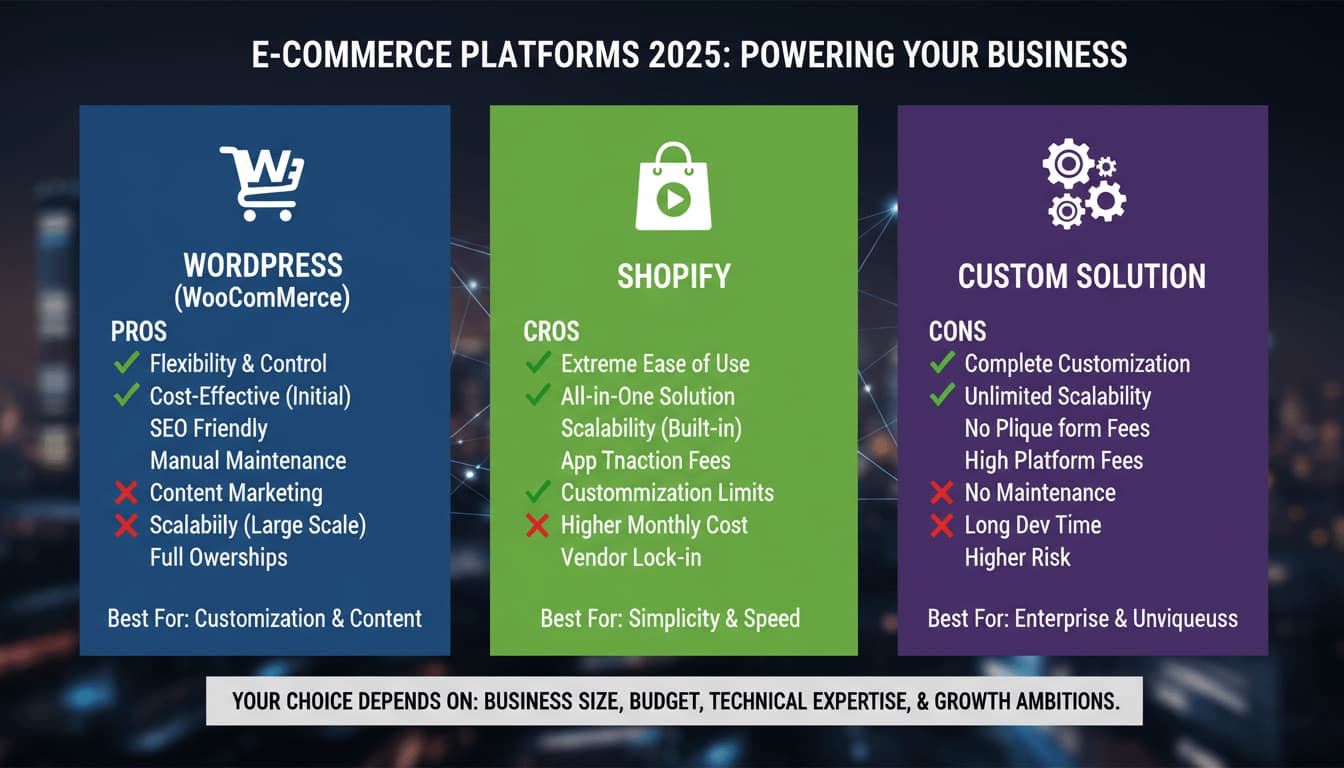
WordPress is usually the strongest fit for content-led, service-led, or hybrid websites that need long-term SEO flexibility and broader customization. Shopify is generally the fastest route for ecommerce-first businesses that want cleaner day-to-day store operations. Custom development makes the most sense when the business model is unusually complex and needs maximum control, even though it usually comes with the highest upfront investment and the slowest launch path.
How to Decide More Clearly
A useful way to decide is to ask what the website must become over the next two to three years. If it is mainly a content, lead-generation, or hybrid growth platform, WordPress is often the strongest fit. If it is first and foremost a store, Shopify usually reduces operational complexity. If the website is closer to a software product or business engine than a standard marketing site, custom development may be worth the investment.
This is why future direction matters as much as present needs. The platform should not only support launch. It should also support what happens after the business grows, the strategy matures, and new requirements appear.
Ready to improve your Shopify store?
Get a sharper plan for Shopify growth.
Talk through theme decisions, speed issues, merchandising, product discovery, and conversion improvements with the Zeroradius team.
Final Thoughts
WordPress, Shopify, and custom development are not interchangeable answers to the same question. They solve different kinds of business problems. WordPress wins on flexibility and SEO depth. Shopify wins on commerce simplicity. Custom development wins when the business model itself needs more than a standard platform can comfortably provide.
The right choice is the one that matches your business model, your growth path, and the level of control you will need later, not just the one that seems easiest during the first few weeks of planning.
If you want help choosing the right route, Zeroradius works across WordPress development, Shopify development, and broader website strategy so the decision is based on fit rather than guesswork.
Have questions?
Yes. It remains one of the strongest choices for businesses that need content flexibility, SEO strength, and room to grow over time.
Often yes when ecommerce is the main focus, because Shopify is built around store operations from the start.
Choose custom development when the website needs unusual functionality, deep workflow customization, or product logic that standard platforms cannot support well.