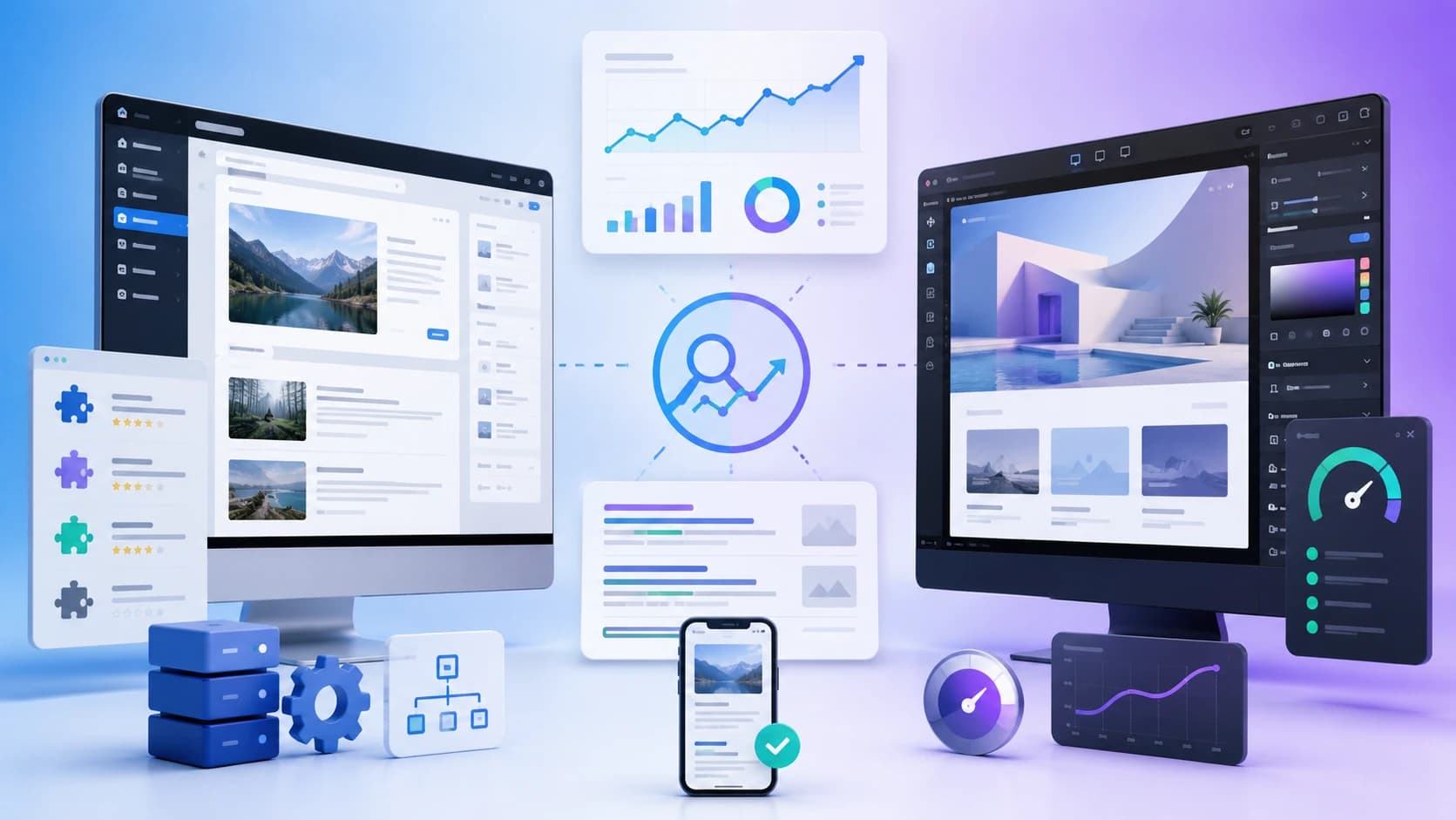

AI has made website creation much faster. It can generate layouts, draft copy, suggest sections, and produce something that looks finished in a surprisingly short amount of time. That has led many people to ask whether platforms like WordPress are finally becoming unnecessary. On the surface, it sounds plausible. If a prompt can generate a site in minutes, why keep relying on a system that often involves more setup, more decisions, and more ongoing management?
The answer becomes clearer once the website has to do more than look acceptable. Businesses do not only need a homepage and a few pages of content. They need flexibility, integrations, SEO depth, performance control, ownership, and room to grow without hitting invisible platform limits. That is where WordPress still holds a major advantage.
AI Is Fast, but Speed Is Not the Whole Job
AI website builders are genuinely good at removing blank-page friction. They are helpful when the immediate goal is to get a basic structure online quickly. That matters for prototypes, simple landing pages, early-stage ideas, or businesses that need a rough first version without much complexity.
But the needs of a real business usually move beyond that stage quickly. The moment the site needs more specific user flows, stronger SEO structure, custom forms, layered content architecture, better analytics, integrations, or deeper brand control, speed alone stops being the deciding factor. Reliability and flexibility start to matter much more.
WordPress Wins on Control
One of WordPress’s biggest advantages is that it gives businesses more control over how the site behaves and evolves. The platform can be simple when it needs to be, but it can also support far more complex use cases than most AI-generated builders are comfortable handling. That matters because real businesses almost always outgrow a “good enough” setup once their digital needs become more specific.
With WordPress, you can shape the site around the business rather than forcing the business to stay inside a predefined system. That difference becomes more important over time, not less.
SEO Requires More Than Generated Content
One of the most common misunderstandings around AI websites is the assumption that content generation solves SEO automatically. It does not. Search performance depends on structure, intent alignment, internal linking, topical depth, technical clarity, and the wider authority of the site. AI can help support parts of that process, but it does not replace the strategic layer behind it.
WordPress remains strong because it allows that strategy to be implemented with much more flexibility. Businesses can shape page structure, schema, plugin workflows, editorial processes, and content more deeply. Our related guides on WordPress SEO growth and AI SEO plugins for WordPress explore that advantage in more detail.
AI Tends to Flatten the Edges of Real Brands
AI is excellent at producing competent, familiar output. That is also one of its limitations. Businesses that need a more distinct digital identity often discover that AI-generated websites look polished but interchangeable. They borrow from patterns that already exist well enough to feel safe, but not necessarily enough to feel memorable.
WordPress does not create originality by itself, of course, but it gives designers, developers, and content teams more freedom to build something that actually reflects a brand instead of settling for the average of what AI can produce quickly.
Ownership Matters More Than People Expect
Another major difference is ownership. Many AI-led website systems come with stronger platform dependency. The business is tied more closely to that environment’s pricing, limits, capabilities, and future decisions. When the platform changes direction, the business has to adapt.
WordPress usually offers more independence. The business can choose its hosting, shape its stack, control its data more directly, and avoid being boxed into a narrowly controlled system. That freedom becomes much more valuable once the website starts carrying serious commercial weight.
WordPress Also Works Well With AI Instead of Against It
One reason the “AI versus WordPress” framing is misleading is that the two are not natural enemies. In many cases, the strongest workflow is to use AI inside a WordPress system rather than trying to replace the system entirely. AI can help with first drafts, repetitive content work, SEO assistance, chatbot support, and management workflows while WordPress continues to provide the flexibility and control underneath.
That combination is much more realistic than expecting AI alone to replace a platform that businesses rely on for real operational depth.
Scaling Exposes Weak Platforms Quickly
Lightweight AI site generation can look impressive at the beginning, but scaling usually exposes the limits. More traffic, deeper SEO goals, more content, more integrations, and more custom workflows all increase pressure on the platform. This is where WordPress often proves more durable because it can keep evolving with the business rather than forcing a rebuild once the easy phase is over.
Our WordPress in 2026 article and WordPress performance guide are useful related reads if long-term platform quality is the real concern.
Planning a better WordPress website?
Turn this WordPress insight into a stronger build.
Get help with WordPress strategy, design, performance, content structure, and long-term maintainability.
Final Thoughts
AI still cannot replace WordPress because building a serious business website involves more than generating a passable first version quickly. It involves control, flexibility, ownership, performance, SEO strategy, and the ability to keep growing without being trapped by the system that got you started.
AI is valuable. In many WordPress workflows, it is becoming increasingly helpful. But that is exactly the point: it works best as an enhancer of WordPress, not as a full replacement for what WordPress makes possible.
Have questions?
No. AI can accelerate many parts of website creation and management, but WordPress still offers deeper control, flexibility, and ownership for businesses that need more than a quick first version.
AI can be very useful for drafts and workflow support, but businesses with serious growth, SEO, or customization needs usually benefit more from using AI alongside WordPress rather than instead of it.
Yes. It remains one of the most capable and widely supported platforms for businesses that need a website to grow with them over time.