
We review your existing ecommerce platform, store structure, data, integrations, functionality, SEO requirements, and business objectives to establish the migration scope.
BigCommerce Migration Services
Move your ecommerce store to BigCommerce with a structured migration strategy designed around your data, products, customers, content, and business requirements.
Why BigCommerce Migration Matters for Your Business
Moving an ecommerce store to a new platform involves more than transferring products.
Your store may contain customer records, orders, categories, content, URLs, metadata, integrations, and business rules that need to be assessed and mapped to the new environment.
A structured migration approach can help your business move essential store data, protect important SEO signals, reduce operational disruption, and map existing functionality to the right BigCommerce solution.
Zeroradius approaches migration as a structured process rather than a simple data transfer, combining technical migration, ecommerce requirements, SEO considerations, and launch planning.

Technology benefits
Moving an ecommerce store to a new platform involves more than transferring products.
Our Process
We approach BigCommerce migration as a structured replatforming process so data, functionality, SEO, validation, and launch planning are handled together rather than as disconnected tasks.
We create a migration plan covering data sources, destination structures, migration stages, dependencies, testing requirements, redirects, integrations, and launch considerations.
We map existing products, categories, customers, orders, content, attributes, and other relevant data to their corresponding BigCommerce structures.
Where required, data is transformed to match BigCommerce structures before being transferred and validated within the new store.
We identify existing platform functionality and determine how it will be implemented on BigCommerce through native features, apps, integrations, or custom development.
We configure the BigCommerce environment, including relevant store settings, catalogue structures, theme requirements, integrations, and other migration-related components.
We validate migrated data, storefront functionality, links, redirects, integrations, customer journeys, and key ecommerce workflows before launch.
We coordinate the transition to the new BigCommerce storefront and provide post-migration support to address issues, refinements, and ongoing requirements.

Work With Zeroradius
Move Your Ecommerce Store to BigCommerce
A successful migration requires more than moving data from one platform to another. Your catalogue, customers, content, integrations, URLs, functionality, and business processes all need to be considered before launch.
Moving an ecommerce store to a new platform involves more than transferring products. Your store may contain customer records, orders, categories, content, URLs, metadata, integrations, and business rules that need to be assessed and mapped to the new environment.
Insights
View All Articles
Featured Article
BigCommerce Development Services by Zeroradius
Explore BigCommerce development services from Zeroradius, including storefront UX, custom development, integrations, migration, SEO, and performance support.
Read Article
Why Businesses Choose Zeroradius for Ecommerce Development
Learn why businesses choose Zeroradius for ecommerce development, including strategy, platform selection, UX, custom development, performance, and support.


How Zeroradius Builds High-Converting Ecommerce Websites
See how Zeroradius approaches high-converting ecommerce websites through strategy, UX, performance, platform decisions, and continuous improvement.

Best Ecommerce Platforms Used by Ecommerce Development Companies in 2026
Compare the ecommerce platforms development companies use in 2026, including Shopify, WooCommerce, BigCommerce, headless commerce, and custom builds.

BigCommerce B2B Ecommerce Development Guide
A practical guide to BigCommerce B2B ecommerce development, covering buyer workflows, pricing logic, company accounts, reordering, integrations, and long-term scalability.

BigCommerce Development: How to Build a Scalable Ecommerce Store for Growth
A practical guide to BigCommerce development for growing brands, covering store structure, product pages, performance, B2B needs, SEO, and long-term scalability.

How AI Can Make WordPress Management More Efficient
A practical guide to using AI in WordPress management for content workflows, maintenance, monitoring, performance, and lead handling without over-automating the site.
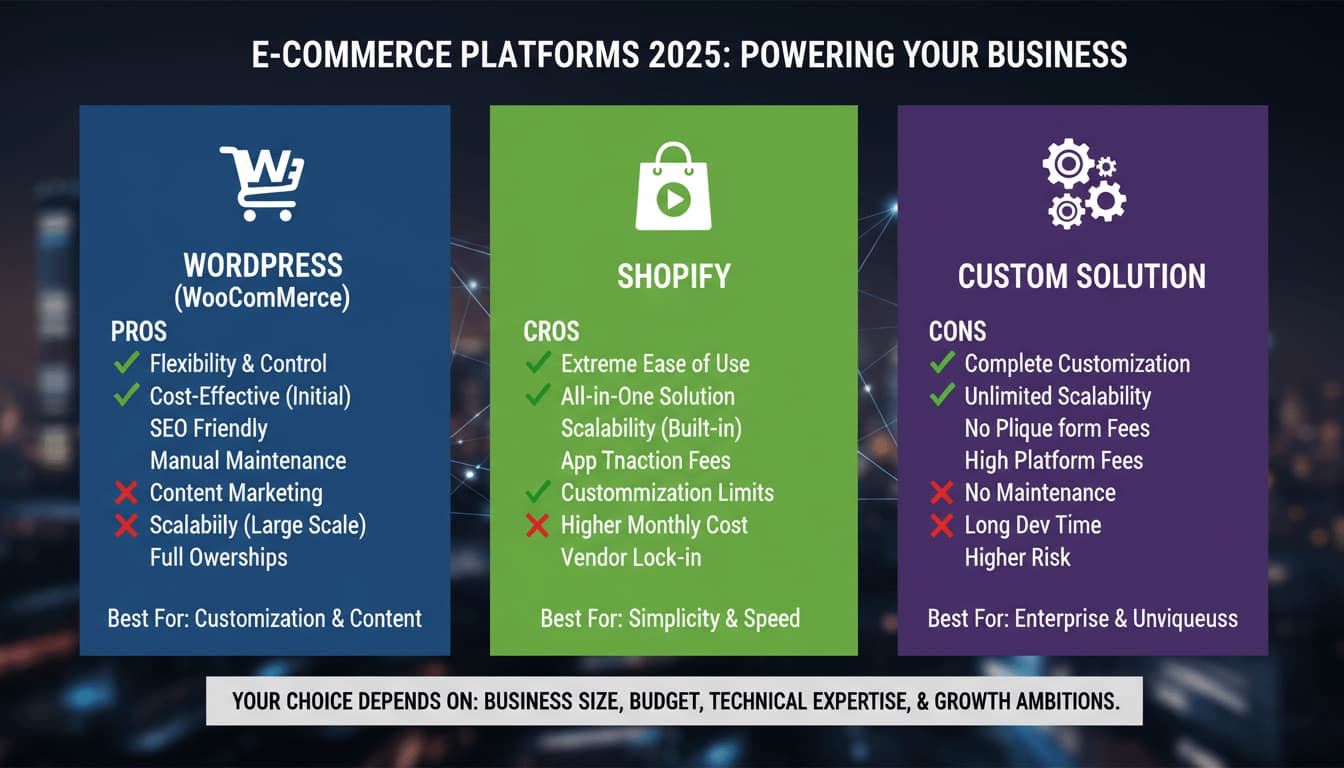
WordPress vs Shopify vs Custom: Which Platform Is Right for Your Business?
A practical comparison of WordPress, Shopify, and custom website development, with clear guidance on which platform fits different business goals, budgets, and growth plans.

WooCommerce Development Services by Zeroradius
Explore WooCommerce development services from Zeroradius, including custom stores, theme work, plugin support, integrations, migration, SEO, and maintenance.

Shopify Development Services by Zeroradius
Explore Shopify development services from Zeroradius, including store strategy, theme work, custom features, integrations, speed, SEO, and ongoing support.

13 Essential Elements Every High-Performing Online Store Needs in 2026
Learn the essential elements of a high-performing online store, from speed and mobile UX to trust signals, product pages, checkout, and post-launch optimization.
Frequently Asked Questions
Need a more specific answer? Talk to us and we'll point you in the right direction.
BigCommerce migration is the process of moving an ecommerce store from an existing platform to BigCommerce, including relevant products, customers, content, catalogue structures, functionality, integrations, and other supported data.
The migration approach depends on the source platform and its available data export and API capabilities. The specific migration process can be assessed based on your current ecommerce platform and store structure.
Depending on the source platform and available data, migration may include products, categories, variants, customers, orders, images, pricing, attributes, content, and other supported ecommerce information.
Yes. Customer data migration can be planned based on the source platform's data structure, BigCommerce's supported fields, available APIs or exports, and applicable data requirements.
Yes. Product data migration can include relevant product information, categories, variants, attributes, images, pricing, and other catalogue information supported by the source and destination platforms.
Order migration depends on the source platform, available data, BigCommerce capabilities, and the requirements of the project. The required order fields and historical data should be assessed before migration.
SEO preservation should be treated as a migration objective rather than a guaranteed outcome. A migration can include URL mapping, redirects, metadata, content, internal links, and other SEO considerations, but search rankings can also be affected by changes to the site, content, platform, competition, and search engine evaluation.
Existing URLs can be mapped to appropriate BigCommerce URLs, with redirects planned where URL structures change. The exact implementation depends on the source and destination URL structures.
A migration can be planned to minimize disruption, and some migration approaches can support a launch with little or no interruption. However, actual downtime depends on the source platform, migration method, data synchronization, launch process, and technical conditions, so downtime cannot be guaranteed to be zero.
Migration processes can include source data backups or exports, structured data mapping, validation, test migrations, record comparisons, and post-transfer checks. Complete zero data loss cannot be guaranteed because the outcome depends on source data quality, platform capabilities, mapping, and technical conditions.
Data mapping is the process of matching fields and structures from the existing ecommerce platform with their corresponding fields and structures in BigCommerce.
Feature mapping involves reviewing the functionality of your existing store and determining how each feature can be reproduced, replaced, adapted, or integrated within BigCommerce.
Existing integrations can be assessed during migration planning. Depending on the integration, it may be possible to reconnect it, replace it with a BigCommerce app, use an API integration, or develop a custom solution.
Yes, a custom ecommerce website can be assessed for migration to BigCommerce. The process involves identifying the existing data structures, functionality, integrations, content, and technical requirements before determining the appropriate migration approach.
SEO considerations can be incorporated into the migration process, including URL mapping, redirects, metadata, content structures, internal links, and other relevant technical elements.
The timeline depends on the source platform, catalogue size, customer and order data, content, integrations, custom functionality, data transformation requirements, testing, and launch scope.
Migration cost depends on the complexity of the existing store, amount of data, number of integrations, custom functionality, data transformation, SEO requirements, testing, and post-migration support.
Yes. Post-migration support can address data validation, integration issues, storefront refinements, configuration changes, functionality issues, and other requirements that arise after launch.
Start your BigCommerce migration project
Ready to Move Your Store to BigCommerce?
Tell us about your current ecommerce platform, the data you need to migrate, your integrations, SEO requirements, and your launch goals. We can help define the right BigCommerce migration approach for your business.