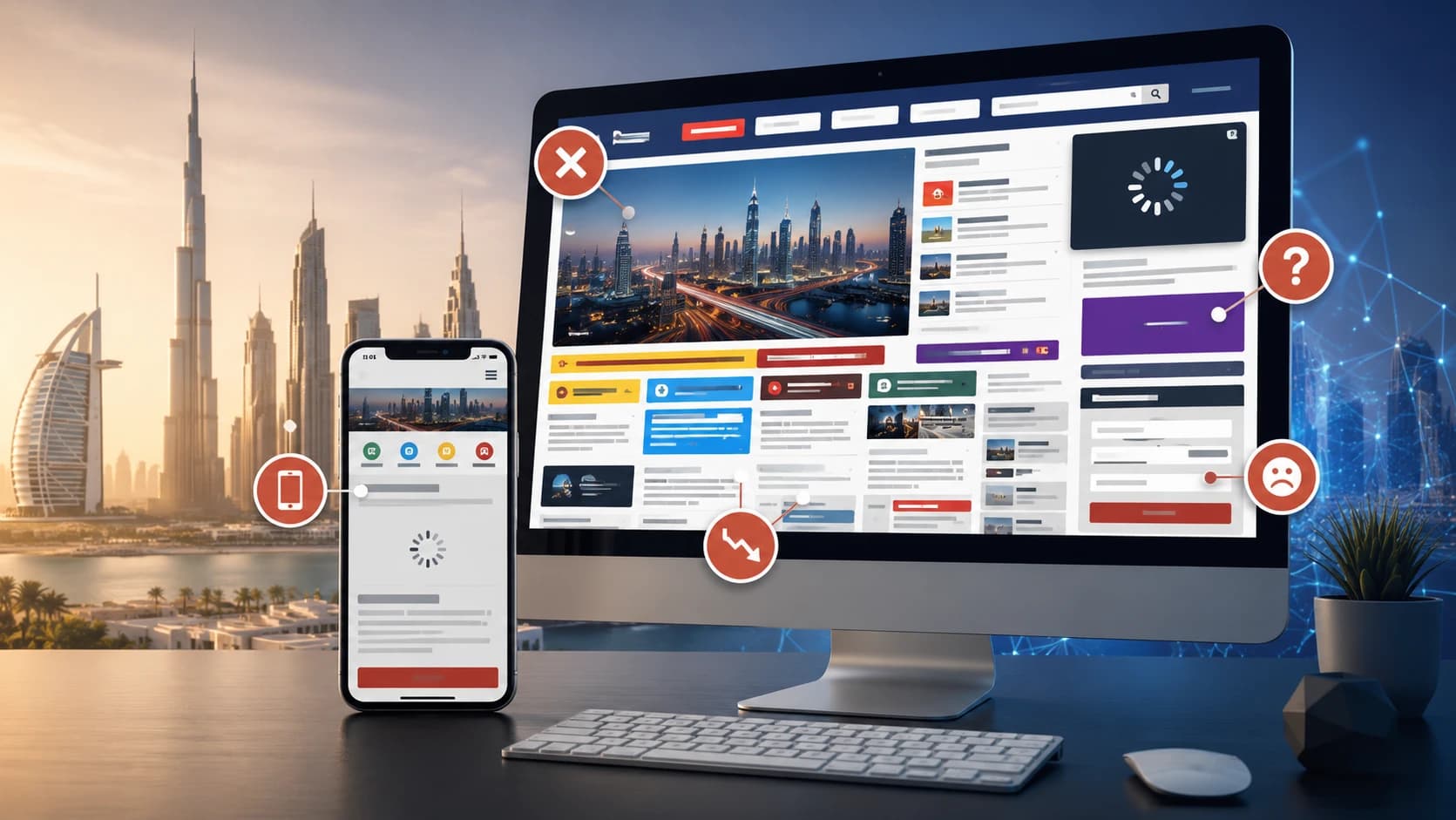
Dubai businesses often invest serious money in branding, advertising, and website development, yet many still end up with sites that underperform in search and convert poorly. The issue is rarely a total lack of effort. More often, it is a collection of avoidable decisions that weaken the experience for users and make the website less effective as a sales tool.
In a market as competitive and fast-moving as Dubai, even small mistakes can become expensive. A slow mobile experience, weak local SEO, unclear calls to action, or outdated page structure can quietly reduce enquiries while competitors capture the same audience more effectively. The businesses that perform well online usually do not win because their websites are louder. They win because their websites are clearer, faster, and easier to trust.
Many Websites Are Still Built for Desktop Thinking
One of the most common mistakes is treating mobile as a secondary check rather than the main environment. That approach no longer reflects how people browse. In Dubai especially, a large share of discovery, comparison, and enquiry behavior happens on phones. If a site looks fine on desktop but feels awkward on mobile, the business is losing opportunities before the visitor even reaches the message.
Mobile-first design is not just about making layouts responsive. It is about making text readable, forms easy to complete, navigation obvious, and buttons comfortable to tap. It also means checking whether the page still feels polished and fast on real devices rather than only inside a design file.
Website Speed Still Has a Direct Commercial Impact
Performance problems remain one of the easiest ways to lose both rankings and trust. Users in competitive markets tend to compare options quickly. If a page takes too long to load, feels heavy, or shifts around while content appears, the impression of quality drops immediately.
Slow websites are often caused by the same avoidable patterns: oversized images, unoptimized scripts, poor hosting choices, and unnecessary visual effects. Fixing these issues usually improves more than just speed. It also improves the perceived professionalism of the brand. Businesses that care about growth should treat performance as part of the user experience, not as a technical afterthought.
Local SEO Is Often Too Weak or Too Generic
Another common problem is publishing a website that could belong to almost any market. A Dubai business may describe its services well enough, but if the content does not carry clear local relevance, it becomes harder to compete in location-based search. Search engines need stronger signals, and users often do too.
That does not mean forcing the word “Dubai” into every sentence. It means building genuinely useful local relevance through titles, service pages, metadata, FAQs, geographic cues, structured data, and content that reflects how customers in the region actually search. When that layer is missing, the website may look acceptable but struggle to gain local visibility.
Weak Calls to Action Create Quiet Drop-Off
Many websites lose leads simply because they never make the next step feel obvious. A visitor may understand the service and even like the brand, but if the CTA is generic, hidden, or disconnected from the page content, that intent can fade quickly.
Strong calls to action do not need to be aggressive. They need to be clear. They should help visitors understand what happens next and why that step is worth taking. In service businesses, specific language usually works better than vague prompts. A CTA that reflects the user's goal tends to perform better than one that sounds like a default template.
Outdated Design Still Damages Credibility
Dubai is a market where expectations around presentation are high. That does not mean every website needs to look luxurious, but it does mean the site should feel current, intentional, and professionally maintained. When a business operates in a modern, quality-sensitive market but its website feels cluttered, dated, or inconsistent, credibility suffers quickly.
Good design is not only about appearance. It helps users process information faster, understand the brand more easily, and move through the site without friction. If the layout is visually noisy, the typography is weak, or the branding changes from section to section, the overall experience feels less trustworthy even when the service itself is strong.
Too Many Businesses Still Launch Without Proper Tracking
A surprising number of websites go live without meaningful analytics or conversion tracking. That leaves the business guessing. It becomes difficult to know which channels bring qualified visitors, which pages support lead generation, and where users are dropping off.
Without that information, improvement becomes slower and more expensive. A business may continue investing in design or marketing without understanding whether the real issue sits in messaging, UX, form friction, or traffic quality. Tracking does not solve the problem by itself, but it makes better decisions possible.
Thin Content Limits Search Growth
Some business websites rely only on a homepage and a few short service pages. That can be enough for a basic online presence, but it is rarely enough to build sustained search visibility in a competitive market. Businesses that want better performance usually need a stronger content structure around their core services.
That might include service-specific pages, educational articles, local FAQs, industry insights, and internal links that help users move naturally from discovery to enquiry. The goal is not to publish content for the sake of volume. The goal is to create a cleaner and more useful path for both search engines and customers.
Want a clearer user experience?
Improve the parts of your website users actually feel.
Get support with UX clarity, conversion flow, interface design, and website structure tailored to your goals.
Final Thoughts
Most website mistakes are fixable, but they become much more expensive when they are left in place for too long. Businesses that improve mobile usability, strengthen local SEO, clarify CTAs, modernize the user experience, and pay attention to performance usually see better results not because they have done something flashy, but because they have removed the friction that was holding the website back.
For Dubai businesses, the standard is high and the competition is real. A website has to do more than exist. It has to communicate clearly, perform reliably, and support business growth. That is the difference between a site that looks fine on launch day and a site that continues to work as a commercial asset over time.
Have questions?
One of the biggest mistakes is failing to treat mobile usability, speed, and local SEO as core requirements from the start.
Improve technical performance, strengthen local relevance, build better service content, and make sure the site supports a clear user journey from search to enquiry.
Yes. Speed affects user behavior, perceived quality, and Core Web Vitals, all of which can influence search performance and conversions.
There is no fixed rule, but businesses should review design quality, content relevance, and performance regularly instead of waiting years for obvious issues to accumulate.